Agentic AI Statistics 2026: What BCG and SAP LeanIX Found
Agentic AI now drives 22% of AI value and could hit 39% by 2030. We break down the 2026 BCG and SAP LeanIX research and what it means for your business.


Agentic AI Statistics 2026: What the Latest BCG and SAP LeanIX Research Reveals
Key Takeaways
- Agentic AI is the fastest-growing source of AI value. Its share of total AI value rose from 17% in 2025 to 22% in 2026 and is projected to reach 39% by 2030 (BCG Applied AI Index 2026).
- Adoption is near universal. 98% of companies have deployed AI agents or plan to (SAP LeanIX Agentic AI Survey 2026).
- Management is lagging. 48% of companies have no clear owner for AI agents, and only 17% can see agent performance or ROI (SAP LeanIX).
- Governance multiplies value. Companies with all six agent controls in place generate three times as much agentic AI value, yet only 5% have them (BCG).
- AI is now a business investment, not an IT cost. AI spending averages 3.3% of revenue, with 2.8 percentage points of that outside the IT budget (BCG).
- It's mostly a people challenge. BCG's 10-20-70 model puts 70% of the effort on people, organisation and processes.
Picture the office in 2024. Someone in a meeting says "agents" and half the room nods knowingly while privately wondering whether the company has signed up with a talent agency.
In 2026, the nodding has turned into budgets.
Two major reports have landed this autumn, and together they give the clearest picture yet of where agentic AI really stands: The Formula for Agentic AI Value: BCG Applied AI Index 2026 and the SAP LeanIX Agentic AI Survey 2026.
At Novosapien, we've spent about two years building agentic AI workforces for SMEs and enterprises, so we read both with a highlighter and a strong coffee. Here's what they say, and what it means for your business.
What Is Agentic AI?
Agentic AI is artificial intelligence that completes multi-step work on its own, rather than just answering questions. An AI agent can follow a process, use tools and data, make decisions within agreed limits, and hand back to a human when judgement is needed. A chatbot waits to be asked. An agent gets on with the job.
Is Agentic AI Actually Delivering Business Value in 2026?
Yes. According to BCG's Applied AI Index 2026, almost half of companies now generate measurable value from AI, and agentic AI is the fastest-growing share of it.
For a while, AI ROI was a bit like a gym membership in February: plenty of commitment, not many visible results. That's changing fast:
- The "stagnating" group of companies shrank from 14% to 4.5% in a year.
- 41% of companies are now "scaling" AI and generating value.
- The elite "future-built" group grew from 5% to 7.5%.
- Agentic AI's share of total AI value rose from 17% in 2025 to 22% in 2026, with BCG projecting 39% by 2030. On that path, it becomes the single largest source of AI value.
The leaders are pulling away. BCG finds future-built companies deliver 2.4 times the top-line growth, 2.3 times the three-year shareholder return and three times the EBITDA growth of laggards.
The money is following. Average AI spending has risen to 3.3% of revenue, more than triple the roughly 1% BCG measured a year earlier. Of that, 2.8 percentage points sit outside the IT budget. AI has stopped being an IT line item. It's a business investment.
How Fast Is AI Agent Adoption Growing?
Almost every company is now using or planning to use AI agents: 98%, according to the SAP LeanIX Agentic AI Survey 2026.
The breakdown from SAP LeanIX's survey of 228 enterprise architecture leaders (March 2026):
- 44% already deploy AI agents (5% at scale, 39% in a limited set of functions)
- 40% are experimenting
- 14% plan to start
- 2% have no plans (we'd love to meet them, purely for anthropological reasons)
The honest footnote: only 5% have agents at scale. The door is open, but most businesses are still standing in the hallway.
Why Are Companies Struggling to Manage AI Agents?
Because most companies don't know which agents they have, what those agents achieve, or who is responsible for them. The SAP LeanIX data is blunt:
- Only 9% have full visibility of their AI agent inventory (49% have at least partial visibility).
- Only 17% have any visibility into agent performance, compliance or ROI.
- 38% aren't planning to get that visibility.
- 48% have no clear owner for AI agent management. Several departments are involved at once.
Imagine hiring a dozen new staff, not writing down their names, not checking their work, and letting three departments argue about who runs their appraisals. That's roughly where half of businesses are with AI agents.
Ownership changes everything. Where a dedicated team is responsible for AI agents, 81% of respondents are satisfied with the setup. Where no one clearly owns it, satisfaction drops to 7%.
Does AI Governance Reduce or Increase the Value of AI Agents?
It increases it. BCG found companies with all six agent controls in place enterprise-wide generate three times as much agentic AI value as companies with just one control (1.8% of revenue versus 0.5%).
Yet only 5% of companies have all six in place, even though 42% expect agents to act autonomously by 2030.
BCG's six essential AI agent controls:
- Memory and context: what agents store, recall and share (the biggest value driver, at 32% relative importance)
- Scope and oversight: each agent's purpose, permitted actions and required human oversight
- Evaluation and rollback: continuous monitoring and the ability to undo, not just a launch-day sign-off
- Tools and integration: standard connections and a register of which agents exist
- Ownership: a named human owner for every material agent, with authority to change, pause or stop it
- Security: runtime controls, audit trails and cost guardrails
SAP LeanIX shows the intent is there: 73% of companies see the need for a governance framework specific to AI agents, with 22% already using one and 51% building one.
Our view at Novosapien: governance isn't paperwork. It's what lets you give an agent more responsibility without losing sleep.
What Do AI Leaders Do Differently?
They focus, redesign processes end-to-end and measure results in money. BCG's comparison of future-built companies and laggards:
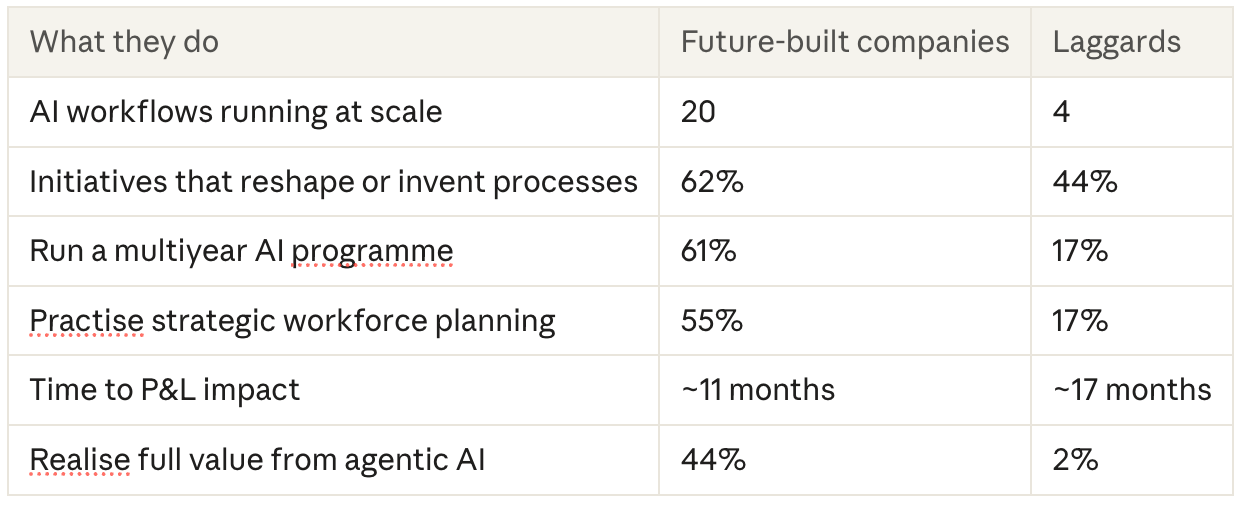
Measurement matters too. 95% of future-built companies track AI through KPIs or the P&L, and companies tracking AI value directly in the P&L see three times the AI value of those that don't measure it (3.6% versus 1.2%).
Two examples from the BCG report show what this looks like in practice:
- A global resources company built an AI agent for master-data change requests (more than 10,000 a year) and cut the process from 68 steps to 3.
- A large US health insurer uses agentic AI to handle about 60% of incoming call types, reducing average handling time by 35%.
Will Agentic AI Replace Jobs?
Mostly, it reshapes work rather than removing it. 89% of executives in BCG's survey expect AI to create new work, while 11% expect it mainly to replace existing jobs.
Companies do expect a workforce reduction of roughly 10-15% overall, concentrated in middle management and frontline leadership. That's why strategic workforce planning matters so much.
SAP LeanIX points the same way: the top obstacle to AI results is lack of employee know-how, ranked first or second by 58% of respondents. Only 15% see the limits of AI technology as a significant hurdle. The technology is largely ready. The organisation often isn't.
That's why BCG recommends its 10-20-70 model: 10% of AI effort on algorithms, 20% on technology and data, and 70% on people, organisation and processes.
How Should a Business Get Started With Agentic AI?
Start with one high-value workflow, give every agent a human owner, and measure outcomes in the P&L. After two years of building agentic AI workforces, this is the sequence we recommend:
- Pick one workflow, not a strategy deck. Choose a process with clear inputs, outputs and a number you can move, such as response time, qualified leads or cost per case.
- Give every agent a manager. Assign a named human owner, a written job description and clear limits on what the agent can and can't do.
- Keep humans in the loop, on purpose. Let agents do the heavy lifting and people make the calls that matter. Increase autonomy task by task as trust is earned.
- Build the controls in from day one. Memory, scope, monitoring, rollback and audit trails make agents more valuable, not less.
- Measure outcomes, not activity. Hours returned, pipeline generated, cost removed. If it can't show up on a P&L, it won't survive budget season.
- Invest in your people. The 70 in 10-20-70 is where the value lives.
This is how we build at Novosapien, whether it's an inbound sales workforce, a cold outreach workforce or a content creation workforce: agents doing the heavy lifting, humans in the lead.
Agentic AI Statistics 2026 at a Glance
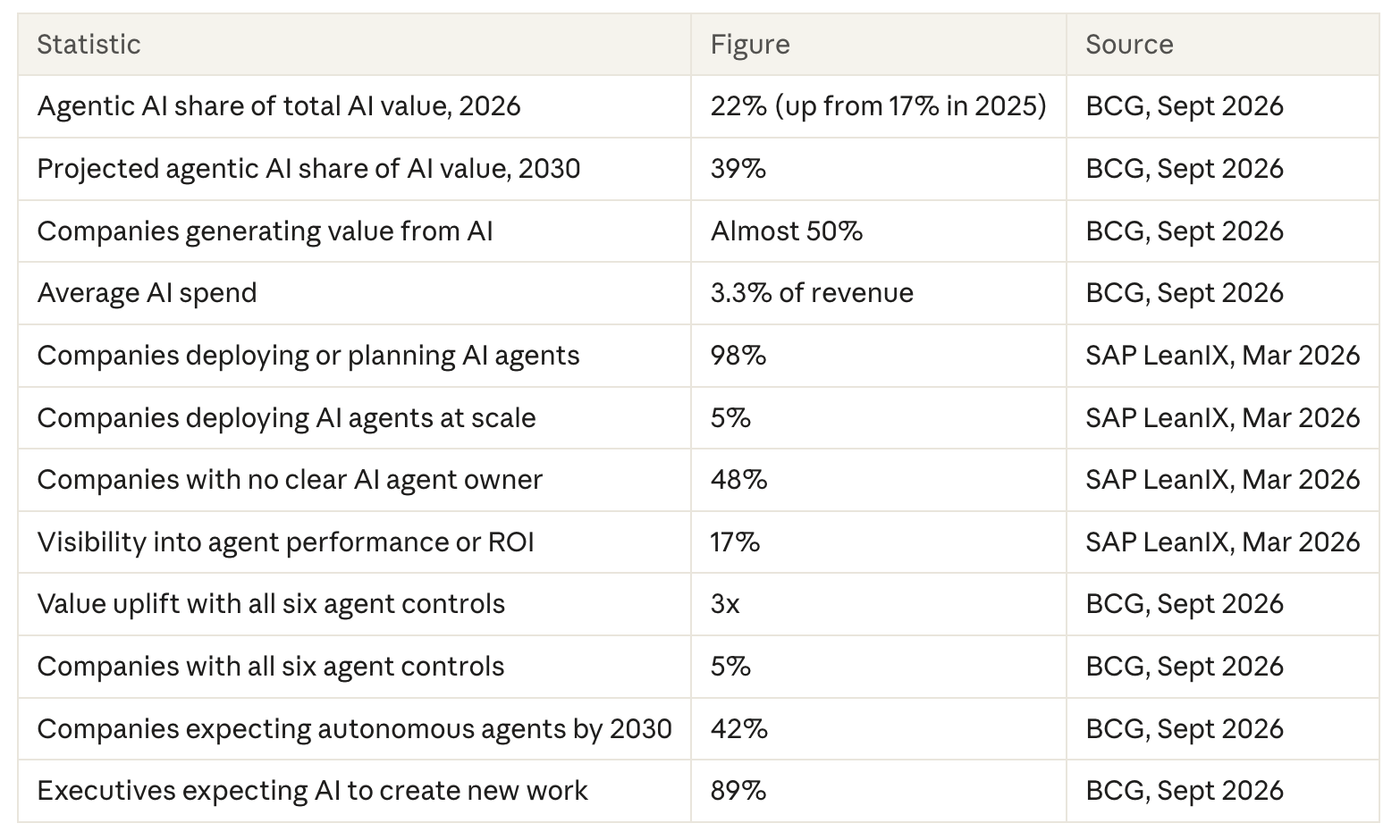
Frequently Asked Questions
What percentage of AI value comes from agentic AI?
Agentic AI accounted for 22% of total AI value in 2026, up from 17% in 2025, according to BCG's Applied AI Index 2026. BCG projects it will reach 39% by 2030, making it the largest single source of AI value.
How many companies are using AI agents in 2026?
According to the SAP LeanIX Agentic AI Survey 2026, 44% of companies already deploy AI agents, 40% are experimenting and 14% plan to. In total, 98% have deployed AI agents or plan to.
What is the biggest barrier to AI agent success?
Lack of employee know-how. 58% of SAP LeanIX respondents rank it as a first or second obstacle, followed by difficulty identifying the right use cases. Only 15% see limitations of AI technology itself as a significant hurdle.
What are the six AI agent governance controls?
BCG identifies six controls: memory and context, scope and oversight, evaluation and rollback, tools and integration, ownership, and security. Companies with all six in place enterprise-wide generate three times as much agentic AI value, but only 5% have them.
Will AI agents replace human workers?
Mostly, they reshape work. In BCG's Applied AI Index 2026, 89% of executives expect AI to create new work and 11% expect it to mainly replace jobs. Companies anticipate a 10-15% workforce reduction overall, concentrated in middle layers.
How long does it take to see ROI from AI?
BCG found future-built companies reach P&L impact from AI in about 11 months, compared with 14 months for scaling companies and 17 months for laggards.
About the Research
- BCG Applied AI Index 2026 ("The Formula for Agentic AI Value", published September 2026): survey of 1,330 CxOs and senior executives across 20-plus sectors and more than 60 countries, combined with financial data from Capital IQ and Orbis.
- SAP LeanIX Agentic AI Survey 2026: online survey of 228 enterprise architects and IT decision-makers in March 2026. 70% of respondents work for European companies and 18% for companies in the US or Canada.
Both are self-reported surveys, so treat them as strong directional evidence rather than precise measurement.
About Novosapien
Novosapien is a UK-based company that builds agentic AI workforces for SMEs and enterprises. Our products include an inbound sales workforce, a cold outreach workforce, a content creation workforce and a custom Workforce Lab. We've been building agentic AI workforces for about two years, always designed around human and AI collaboration, with people kept in the loop.
Want to see what an agentic AI workforce could do in your business? Get in touch with the Novosapien team.
