



Yes. AI can qualify inbound leads 24/7. An AI sales agent replies to a website enquiry within seconds, asks the questions your best salesperson would ask about need, budget, authority and timing, scores the lead against your ideal customer profile, and then books a call or hands the lead to a human with the full conversation attached. At Novosapien, a UK company that builds managed AI workforces, this is what our inbound sales workforce does every night, weekend and bank holiday, while your team keeps every closing conversation.
The reason this matters is simple.
Your buyers do not keep office hours. When Storylane analysed 2,378 B2B website conversations between July and November 2026, 51.6% started outside Monday to Friday, 9am to 6pm.
Those buyers waited an average of 9.8 hours for a reply. That is half your pipeline sitting in an inbox overnight.
What does AI lead qualification actually mean?
AI lead qualification is the use of AI agents to hold a real conversation with a new lead, gather the facts that decide whether they are a good fit, and route them to the right next step without a human doing the first-pass work.
It is different from the two things most businesses already have:
- A web form collects details and waits. Nobody asks a follow-up question until a person picks it up.
- A scripted chatbot follows a decision tree. If the buyer types something off-script, it breaks or loops.
- An AI sales agent understands what the buyer actually wrote, asks sensible follow-up questions, remembers context across email, chat and messaging, and acts on the answers by updating your CRM, booking a meeting or alerting a rep.
Think of it as the difference between a letterbox, a recorded phone menu and a sharp junior SDR who never goes home.
How do AI sales agents find and qualify leads?
AI sales agents qualify leads in five steps: respond instantly, hold a qualifying conversation, enrich and score, take the next action, and hand over to a human with full context.
Here is what happens in each one.
Step 1: Respond instantly, on the buyer's channel
The moment a form is submitted, a chat opens or an email lands, the agent replies. Not with "thanks, someone will be in touch", but with a relevant answer to what the buyer actually asked, followed by a natural question that moves things forward. Good agents work across web chat, email, SMS and WhatsApp, so the conversation continues wherever the buyer prefers.
Step 2: Hold a qualifying conversation
The agent works through the questions that decide fit, in conversation rather than as a form. Most teams base these on a framework they already use, such as BANT (budget, authority, need, timing) or MEDDIC.
For a security installer, that might sound like: "How many sites are we talking about?", "Is this replacing an existing system or a new install?" and "When do you need it live?"
The agent adapts the order and wording to the buyer's answers.
Step 3: Enrich and score against your ICP
While the conversation runs, the agent checks what it can verify: company size, sector, location, website, and any existing record in your CRM. It combines this with what the buyer said and scores the lead against your ideal customer profile.
A 200-person firm with a live project and a decision-maker on the chat scores very differently from a student doing research.
Step 4: Take the right next action
Based on the score, the agent does one of three things:
- Hot lead: books a meeting straight into a salesperson's calendar, often within the same conversation.
- Warm lead: answers remaining questions, sends useful material and sets up a follow-up sequence.
- Poor fit: politely points the buyer to the right resource, so your team never spends time on it.
Step 5: Hand over to a human with full context
When a lead is sales-ready, the agent alerts the right rep and logs the full conversation, the qualification answers and the score in your CRM. The rep walks into the call already knowing the budget, the timeline and the problem.
No "so, tell me a bit about what you are looking for".
Why does speed to lead matter so much?
Because the odds of turning a lead into a customer fall sharply with every hour you wait, and most businesses wait far too long.
The research has been consistent for over a decade. In the original Harvard Business Review study of 2,241 US companies, firms that contacted a lead within an hour were about seven times more likely to qualify it than those that waited even an hour longer, and more than 60 times more likely than those that waited 24 hours. Yet 23% of the companies audited never responded at all.
More recent data tells the same story. Optifai's 2026 benchmark of 939 B2B companies, based on CRM timestamps from Q2 2025 to Q1 2026, found the average lead response time was 47 hours, with only 23% of companies replying within five minutes. Close rates dropped steadily the longer leads waited:
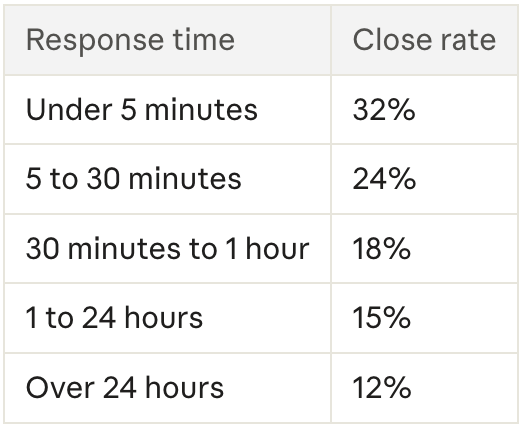
Source: Optifai Pipeline Study, 2026
Put those numbers next to the Storylane finding that half of B2B buyer conversations start outside office hours, and the problem is clear. Even a fast, well-run sales team cannot hit a five-minute response at 9pm on a Sunday. An AI agent can, every time.
What makes the best AI for qualifying inbound leads?
The best AI for qualifying inbound leads responds in seconds, asks your questions in your voice, writes everything back to your CRM, and knows exactly when to hand over to a human. Use this checklist when comparing options:
- Response time in seconds, not minutes. Anything slower than a minute gives the buyer time to open a competitor's tab.
- Your qualification questions, not generic ones. You should be able to define what "qualified" means for your business and change it as you learn.
- Real conversation, not a decision tree. Test it by going off-script. If it loops or stalls, buyers will notice.
- Multi-channel memory. A buyer who starts on chat and replies by email should not have to repeat themselves.
- Two-way CRM sync. Every answer, score and booking should land in HubSpot, Salesforce or whatever you use, without manual copying.
- Calendar booking. Hot leads should be able to book a meeting inside the conversation.
- Clear human handover rules. You decide which leads, topics or deal sizes go straight to a person.
- Tone and brand control. It should sound like your business, not like a default chatbot.
- Reporting you can act on. Response times, qualification rates, meetings booked and reasons leads were disqualified.
AI chatbot vs AI SDR tool vs managed AI workforce
There are three broad ways to put AI on your inbound leads. Each suits a different team.
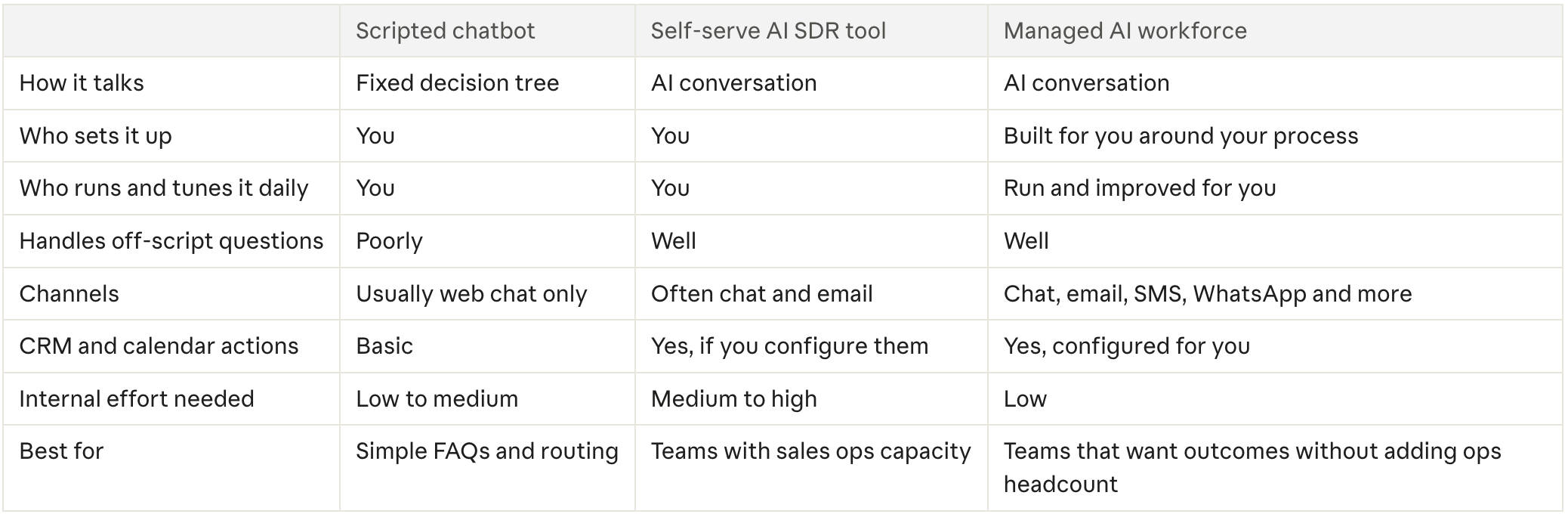
Novosapien builds managed AI workforces. Rather than one bot, an inbound workforce is a small team of specialised agents, for example one that responds and qualifies, one that researches and enriches, and one that books and follows up, all designed around how your sales team already works.
Where do humans stay in the loop?
Humans stay in charge of every decision that matters. The AI does the volume work, the first reply, the questions, the research and the booking, so your people spend their time on conversations that are worth having.
At Novosapien, after two years of building agentic AI workforces, our position has not changed: AI works best alongside people, not instead of them. In practice that means:
- Your team owns the closing conversation. The agent qualifies and books. A human sells.
- You set the rules. Which questions are asked, what counts as qualified, which topics are off limits, and when a lead goes straight to a person.
- Sensitive moments go to people. Complaints, complex technical questions and large deals can be escalated instantly.
- Everything is visible. Every conversation is logged, so a manager can review exactly what was said and why a lead was scored the way it was.
What does this look like in practice?
Here is a typical evening for an inbound workforce working for a UK security installer. (Illustrative scenario.)
- 9:47pm, Sunday. A facilities manager at a logistics firm fills in the contact form: "Need CCTV upgraded across 3 warehouses."
- 9:47pm. The agent replies by email and SMS within seconds, confirms it understood the request and asks whether the upgrade covers access control too.
- 9:52pm. Over a short exchange, the agent learns the sites are in Leeds, Wakefield and Bradford, the current system is eight years old, the buyer is the decision-maker, and the board wants it live by Q2.
- 9:53pm. The agent checks the company's size and location, scores the lead as hot and offers three meeting slots from the sales director's calendar.
- 9:54pm. The buyer books Tuesday at 10am. The CRM record is created with the full conversation, the answers and the score.
- Monday, 8:30am. The sales director opens a summary: who the buyer is, what they need, and the questions still worth asking on the call.
The same lead, sent to a form with a "we will be in touch" message, would have been picked up on Monday morning, by which point the buyer may have already booked a competitor.
Frequently asked questions
Can AI qualify leads as well as a human SDR?
For first-pass qualification, yes, and often more consistently. An AI agent asks every required question every time, never forgets to log an answer and responds in seconds at any hour. Humans remain better at reading nuance in complex deals, which is why the best setups hand qualified leads to a person for the sales conversation.
What questions does an AI agent ask to qualify a lead?
Whatever you define as qualifying. Most teams start with budget, authority, need and timing (BANT), then add questions specific to their business, such as number of sites, current supplier, contract end date or project size. The agent asks them conversationally and adapts to each buyer's answers.
Will prospects know they are talking to AI?
They should. Being open that an AI assistant is handling the first reply builds trust, and most buyers care far more about getting a fast, useful answer than about who types it. Novosapien recommends clear disclosure, with an easy route to a human at any point.
How does an AI agent decide a lead is sales-ready?
It combines what the buyer says with what it can verify, then scores the lead against rules you set. For example, a lead might be marked sales-ready when the company fits your ICP, the buyer has authority, and the project has a timeline within the next three months.
What happens to leads that are not ready to buy yet?
They are not lost. The agent answers their questions, shares useful material and sets up a follow-up sequence, so the conversation restarts when the timing is right. Leads that are a poor fit are politely redirected, so your team does not spend time on them.
Does AI lead qualification work for B2B as well as B2C?
Yes. It is especially valuable in B2B, where deals are larger, buyers research outside office hours, and the cost of a missed lead is high. The qualification questions simply change to reflect company size, decision-making units and project scope.
Ready to stop losing leads overnight?
If half your enquiries arrive when nobody is at their desk, an inbound AI workforce closes that gap without adding headcount, and your team keeps every sales conversation.
Book a walkthrough and we will show you how the inbound workforce would have handled your last 10 website leads.
