Claude Duet vs Grok Bot vs OpenAI Dots: Meet the AI Agents That Work the Night Shift
Three of the biggest names in AI launched always-on agents within ten weeks of each other. Here's what each one does, how they compare, what the benchmarks really say, and what it all means for your business.


Three of the biggest names in AI launched always-on agents within ten weeks of each other. Here's what each one does, how they compare, what the benchmarks really say, and what it all means for your business.
Remember when the most proactive thing your software did was nag you to install an update?
This autumn, AI assistants stopped waiting to be asked. You go to bed, and your agent keeps going: reading the inbox, chasing the follow-ups, preparing tomorrow's brief. By the time you've found your slippers, it has a list of things it needs you to decide.
We've been building agentic AI workforces at Novosapien for about two years, so we've watched this wave arrive with a mix of excitement and professional curiosity. Here's our plain-English guide to the new always-on agents, with a special focus on the newest arrival, Claude Duet.
1. What Just Happened?
A quick timeline of a very busy autumn:
- 11 August: xAI launches Grok Bot in beta.
- 8 September: Meta launches Muse, a personal agent aimed at shopping, travel and household admin (Ecosistema Startup, citing Engadget).
- 29 September: OpenAI launches Dots at its DevDay event.
- 21 October: Anthropic opens a research preview of Claude Duet.
They share one big idea. Each agent gets its own computer in the cloud, complete with a browser, connects to your apps and keeps working after you log off (iPhone in Canada). A chatbot waits for you to ask. These agents go and find the work.
2. Claude Duet: The Chief of Staff
Anthropic's one-line pitch is that the Claude app waits for you to open a chat, whereas Claude Duet comes to you.
Here's what it does:
- Morning brief. Each morning it sends a short summary of the most important items across your connected apps, then goes quiet until something needs you (Claude Duet product page).
- Background monitoring. It checks your connected accounts every few hours, flags decisions and keeps working on its virtual machine even when your laptop and phone are off (all-ai.de).
- Real work, not just reminders. Anthropic says it can handle everything from scheduling to building dashboards and financial forecasts (NewsBytes).
- Almost no setup. It runs on Claude Opus 5.5 and carries over your memory, skills and connected apps from your Claude account, with access to more than 6,000 connectors including Gmail, Slack, QuickBooks and Shopify (iPhone in Canada).
- You talk to it like a colleague. Text or voice, through a standalone iOS and Android app or on the web at claude.ai.
Anthropic's own examples are refreshingly ordinary. Chelsea Larsson, who leads its model and product behaviour design team, hands Duet her to-do list before leaving to be with her kids and picks up the results in an evening report (Anthropic).
The safety design is where Duet stands out. It asks before sending messages, paying, signing or deleting. It never directly sees your passwords, and a new classifier stops it sharing things like card numbers (iPhone in Canada). It also has hard limits: it won't trade securities or move money between accounts, even if you approve (WWWhat's New).
And Anthropic is honest about the rough edges. Duet can misread a thread or misjudge urgency, it's less reliable on personal errands like booking tickets, and it can't yet show you its browser while it works (WWWhat's New).
Who can get it? For now, US Claude Pro and Max subscribers via a waitlist. It isn't on Team or Enterprise plans yet, and its background checks count towards your plan's usage limits (Claude Help Centre). UK readers: we're waiting with you.
3. Grok Bot: The Team You Can Clone
If Duet is a chief of staff, Grok Bot is a small department.
xAI pitches Grok Bot as an AI teammate rather than a feature. You can create several named Bots, run them in parallel, and have them coordinate in a shared thread and pass work to each other (OpenReplay). Its party trick is learning by demonstration: xAI says a Bot can watch you do a task once, turn it into a routine and run it on a schedule.
xAI says Grok Bot began as an internal prototype used across sales, marketing, operations, product and engineering. Suggested jobs include updating CRM entries, drafting sales follow-ups, processing invoices, reproducing software bugs and raising engineering tickets (The Bridge Chronicle).
The safety picture is more of a choose-your-own-adventure. There are approval gates before sending, publishing, buying or deleting, and an independent review model checks proposed actions. But there's also an "Always Allow" option that removes the gate, and reporting by Reworked found every Bot in an account shares one machine, one file system and one set of signed-in sessions (OpenReplay).
Who can get it? Grok Bot has no standalone price. It's included with paid SuperGrok plans (from $30 a month) and Cursor plans (LLM Reference), with Bot work metered separately. Worth knowing for finance teams: its team documentation says there's no Grok Bot-specific spend cap yet (eesel).
4. OpenAI Dots (and a Quick Word on Meta Muse)
OpenAI's Dots sit somewhere between the two. Each Dot runs on GPT-6 Astra, which OpenAI says supports a context window of 1.05 million tokens (ProPakistani). You hand it a goal and it keeps working towards it over time, across more than 4,000 apps, reachable through ChatGPT, Slack, Teams or a voice call. When it's idle, it does "proactive research" to find ways to help (SiliconANGLE).
It's one Dot per person at launch, with teams of Dots promised later. Pro users in the UK, EEA and Switzerland can't get it yet, although Business Premium customers can in all supported regions (PYMNTS).
Meta's Muse is the consumer cousin: built for everyday life admin like shopping and travel rather than work.
5. Side by Side
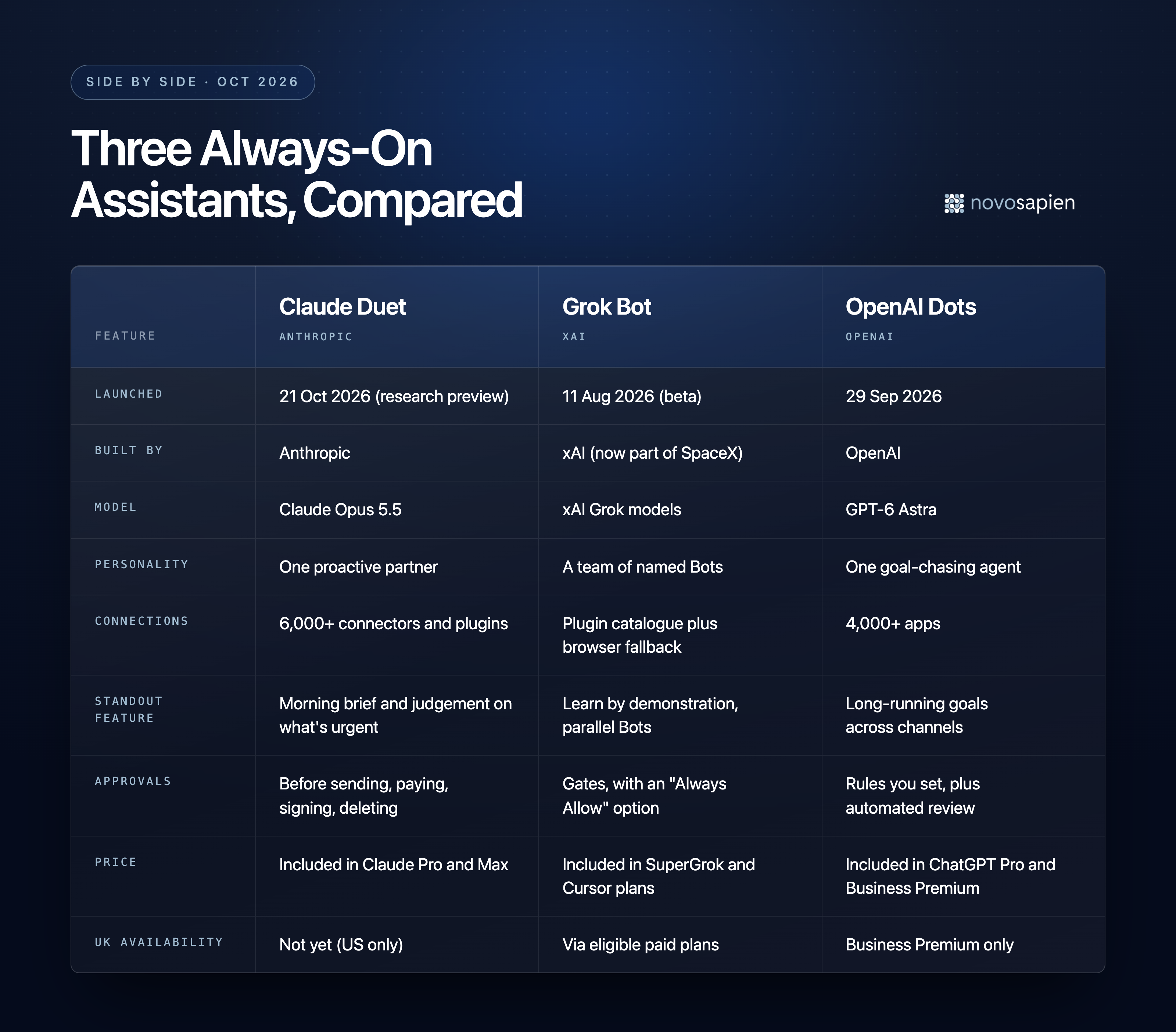
6. So, Which One Is Smartest? What the Benchmarks Say
Here's the slightly awkward truth: there's no benchmark yet for "agent that runs your week". None of the three published product-level performance numbers (WWWhat's New). What we can compare is the engine under each bonnet.
Claude Opus 5.5 (inside Duet), released 22 September 2026, vendor-reported:
- 66.4% on Terminal-Bench 4.0 (agentic tasks in a terminal), ahead of GPT-6 Astra on 57.9% and Opus 5 on 52.3% (Layer3 Labs).
- 81.8% on OSWorld 2.0 computer use with partial credit, or 48.7% under strict marking (LLM Stats).
- 89.9% on SWE-bench Pro for real-world software fixes (LLM Stats).
- It trails GPT-6 Astra on AutomationBench and Terminal-Bench-Science (Emergent).
- API pricing of $4 per million input tokens and $20 per million output (MetricNexus).
Grok 4.6 (the latest Grok model, released 12 August 2026):
- 26% on Terminal-Bench v3.0 in xAI's own table, behind GPT-5.6 Sol on 34.6% (Emergent).
- Strong on knowledge work: 48.1% on Vals AI's Legal Research Bench and 70.8% on its Tax Agent Bench, ahead of GPT-5.6 Terra on both (Vals AI).
- Note that Grok Bot's documentation doesn't name which model version powers it (OpenClaw Database).
A health warning on all of this. Benchmarks only compare fairly when it's the same test, the same version and the same marking. Grok 4.6 scored 26% on Terminal-Bench v3.0 and 88.4% on v2.1, the same model on two versions of the "same" test (Codersera). On the one like-for-like comparison available, Terminal-Bench 4.0, Opus 5.5 leads GPT-6 Astra. Beyond that, treat headline scores as a sign the engine is strong, not proof the car suits your commute.
7. What the Research Says About Getting Value From Agents
This wave lands on top of two big reports we covered recently: BCG's Applied AI Index 2026 (September 2026) and the SAP LeanIX Agentic AI Survey 2026 (March 2026). Together they explain why these launches matter, and where to be careful.
- Agents are where AI value is heading. Agentic AI's share of total AI value rose from 17% in 2025 to 22% in 2026, and BCG projects 39% by 2030.
- Almost everyone is in. 98% of companies have deployed agents or plan to (SAP LeanIX).
- But management is lagging. Only 9% have full visibility of which agents they run, and 48% have no clear owner for them (SAP LeanIX).
- Controls multiply value. Companies with all six of BCG's agent controls generate three times the agentic AI value of those with one, yet only 5% have all six.
Here's the interesting bit. You can see some of BCG's six controls built straight into Claude Duet. Memory and context (BCG's biggest value driver) comes from your Claude account. Scope and oversight shows up as approvals before sending, paying, signing and deleting. Security shows up as credential isolation and a classifier for sensitive data. That's a thoughtful design for a personal agent.
What a personal agent can't give you on its own are the business-level controls: a named owner for each agent, evaluation and rollback across a team, and a register of which agents touch which systems. That's the gap between one person's helpful assistant and a workforce your business can rely on.
8. How We See It at Novosapien
After two years of building agentic AI workforces for SMEs and enterprises, here's our take.
These launches are great news. Millions of people are about to experience what it's like when an agent does real work. That makes conversations about AI in business more grounded and a lot less hypothetical.
Duet gets the human part right. It prepares the work and waits for your OK on anything that matters. That's how we design every workforce we build: agents do the heavy lifting, people make the calls that count. Humans aren't a temporary safety net. They're the judgement, the relationships and the accountability, permanently.
A personal agent isn't a workforce. A business runs on processes that cross teams, data that needs access controls and outcomes someone owns. Our inbound sales, cold outreach and content creation workforces, and custom builds in our Workforce Lab, are designed for exactly that: specialist agents with clear jobs, clear owners and clear limits.
Measure outcomes, not features. Hours returned, response times, pipeline generated, cost removed. BCG's 10-20-70 rule says 70% of AI success comes from people, organisation and process. No benchmark measures that bit.
The Bottom Line
Claude Duet, Grok Bot and Dots mark the moment AI agents went mainstream. Duet is the careful chief of staff, Grok Bot is the clone-able team, and Dots is the goal-chaser with big plans. None of them has published proof of how well it handles your actual week, and the benchmarks need reading with a raised eyebrow.
But the direction is clear. Agents are moving from "answer my question" to "get this done". The businesses that win will be the ones that pair that capability with clear roles, sensible limits and people firmly in the lead.
If you'd like to explore what an agentic AI workforce could look like in your business, get in touch with the Novosapien team.
Quick FAQ
What is Claude Duet?
Claude Duet is Anthropic's proactive AI agent, launched as a research preview on 21 October 2026. It runs on Claude Opus 5.5, sends a morning brief, monitors your connected apps, works in the background and asks for approval before sensitive actions like sending messages or paying.
Is Claude Duet available in the UK?
Not yet. The research preview is open to US Claude Pro and Max subscribers through a waitlist, and Anthropic hasn't announced dates for other countries.
What's the difference between Claude Duet and Grok Bot?
Duet is one proactive partner that prepares work and waits for your approval, with hard limits on actions like moving money. Grok Bot lets you run a team of Bots in parallel that can learn tasks by demonstration, with approval gates you can switch to "Always Allow".
Which always-on AI agent is best?
It depends on the job. On the one like-for-like benchmark available, Terminal-Bench 4.0, Claude Opus 5.5 (inside Duet) leads GPT-6 Astra (inside Dots). None of the three has published product-level results, so the best test is a few weeks of use on your own work.
Sources
- Anthropic, Introducing Claude Duet, 21 October 2026
- Anthropic, Claude Duet product page
- Claude Help Centre, Get started with Claude Duet
- iPhone in Canada, Claude Duet Is Anthropic's Answer to Muse, Grok Bot and OpenAI Dots, 21 October 2026
- all-ai.de, Claude Duet: Anthropics Gegenentwurf zu OpenAI dot und Grok Bot, October 2026
- WWWhat's New, Anthropic lanza Claude Duet, 21 October 2026
- NewsBytes, Anthropic announces Claude Duet, October 2026
- Ecosistema Startup, Anthropic lanza Claude Duet, su agente de IA para pymes, October 2026
- xAI, Introducing Grok Bot, 11 August 2026
- The Bridge Chronicle, xAI Unveils Grok Bot as AI Teammate, August 2026
- OpenReplay, Conoce Grok Bot, 14 September 2026
- LLM Reference, Grok Bot
- eesel, Grok Bot pricing 2026
- OpenClaw Database, Grok Bot Pricing and Usage, checked September 2026
- TechCrunch, OpenAI launches Dots, 29 September 2026
- SiliconANGLE, OpenAI launches Dots, 29 September 2026
- ProPakistani, OpenAI Launches Personal AI Agents That Work 24/7, 30 September 2026
- PYMNTS, OpenAI Launches Dots to Capture AI Agent Market, 29 September 2026
- Layer3 Labs, Claude Opus 5.5 Benchmarks, September 2026
- LLM Stats, Claude Opus 5.5: Fable-Class Work, Cheaper to Run, September 2026
- MetricNexus, Claude Opus 5.5: Benchmarks, Pricing, and Real Costs, September 2026
- Emergent, Claude Opus 5.5 Benchmarks and Grok 4.6 Benchmarks, 2026
- Vals AI, Grok 4.6 vs GPT-5.6 Terra
- Codersera, Grok 4.6 Benchmarks Explained, 2026
- BCG, The Formula for Agentic AI Value: Applied AI Index 2026, September 2026
- SAP LeanIX, Agentic AI Survey 2026, March 2026
