Scale Content Without Hiring: Beat the Headcount Ceiling
When your next post needs a hire, you have hit the headcount ceiling. See how B2B teams grow content output without hiring and keep control.


The headcount ceiling is the point where your content output can only grow by hiring another person. If publishing one more post a week means another salary, you have hit it.
A Content Workforce lifts that ceiling by adding capacity and consistency, while you keep the final say on what goes live.
Key takeaways
- Most B2B content teams are small. The Content Marketing Institute (CMI) found that 54% of dedicated teams have two to five people, and 54% of marketers name lack of resources as a top challenge.
- AI tools alone have not removed the ceiling. About nine in ten marketers use AI to produce content, yet fewer than four in ten say it has improved performance.
- The business case rests on three things: capacity, consistency, and control.
- On the Content Creation Workforce, you set the approval threshold and nothing publishes until you say so.
What is the headcount ceiling?
Every content programme runs on a quiet formula. Output equals people multiplied by hours, so publishing more means hiring more. That works until the budget, or the hiring market, says no.
The numbers show how tight it is. CMI's B2B outlook for 2025 found that 76% of B2B marketers have a dedicated content person or team, and that 54% of those teams have two to five people. Some 54% named lack of resources as a top challenge, and 64% expected their team size to stay the same. (The survey was fielded between June and August 2024.)
The hiring route is not where the money is heading either. In CMI's October 2025 release, human resources, meaning salaries, training and development, ranked last among 2026 investment areas at 9%, while 45% named AI-powered marketing tools as a top-three area for increased investment.
The pressure builds from both sides. Expectations for output rise, and headcount stays put.
Why does more content usually mean another hire?
Because content is not one job. It is research, strategy, writing, design, publishing and learning from the results. Add a channel and you add all six jobs again.
CMI's data shows where it hurts. 42% of marketers struggle to create content consistently, 39% to create enough of it, and 37% to repurpose it. Those are capacity problems wearing a quality label.
A chatbot helps with one of the six jobs, the drafting. That is why the numbers look the way they do. According to CMI's latest research, about nine in ten marketers use AI to produce content, but fewer than four in ten say it has improved performance. In CMI's words, "Productivity is up, but creativity and quality often lag." More drafts, same bottleneck: someone still has to decide, check, design and ship. (We cover this in more depth in Article 2 of this series, Why a chatbot is not a content team.)
Hire or workforce: how do the two routes compare?
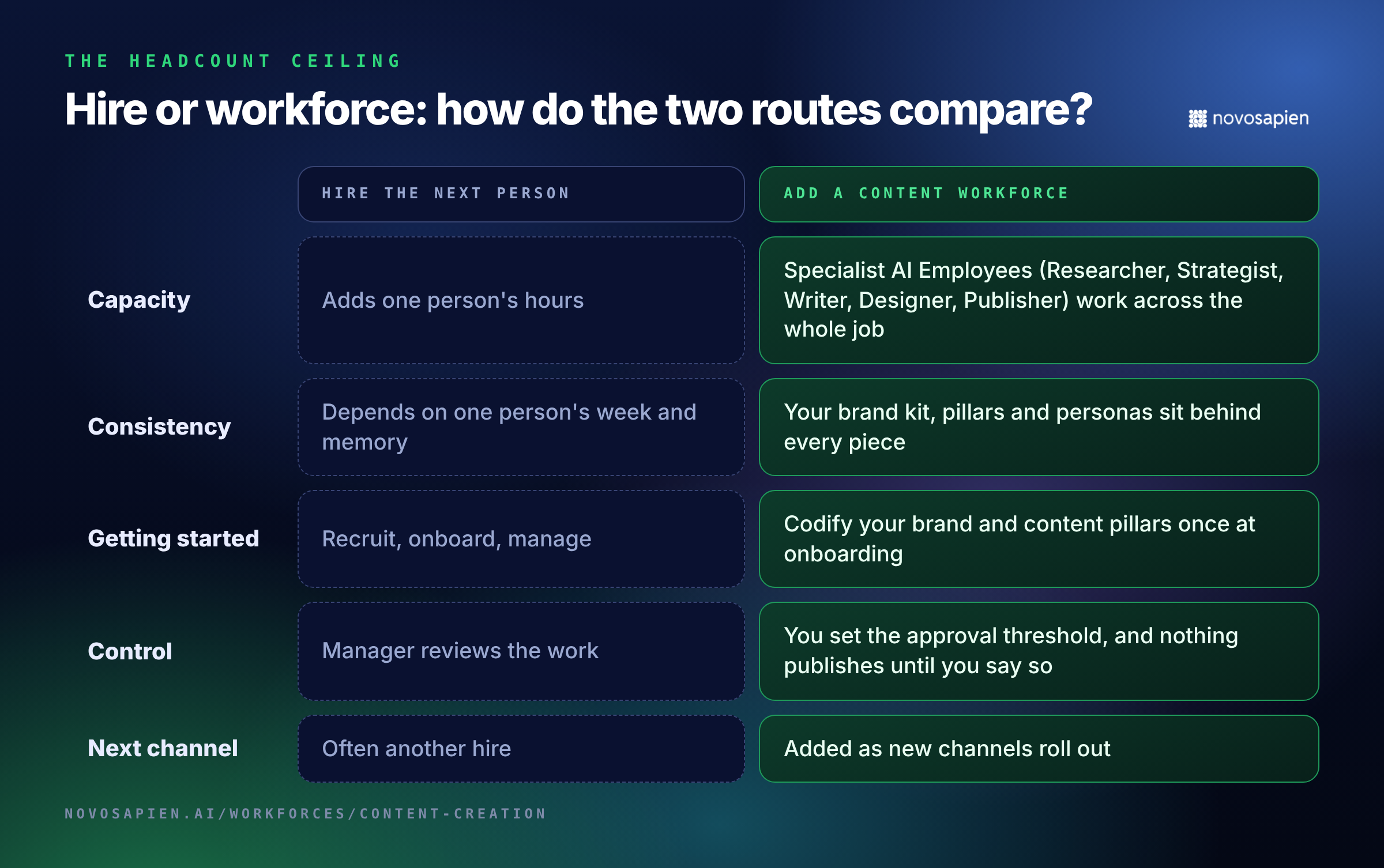
The table is deliberately about the work, not about cost. The right comparison for your business uses your own salary and recruitment figures.
How does a Content Workforce lift the ceiling?
Novosapien builds AI Workforces for revenue work.
The Content Creation Workforce is described as a team of specialist AI Employees that takes one idea and runs it to published across your active channels. It works in five steps: Codify, Ideas, Create, Publish and Compound.
The effect on capacity is simple. An idea no longer waits for a person to be free at each step. The research, the strategy, the draft, the visual and the publishing are handled in sequence by specialists that work from the same brand inputs.
That is also where consistency comes from. Voice is not left to whoever is writing this week.
Your brand kit, pillars and personas become the base behind every piece.
One scope note. Today the workforce publishes straight to LinkedIn and X, with TikTok, YouTube, Instagram and more listed as rolling out.
Who keeps the final say?
You do. This is the question every senior leader asks next, and it matters most. On the product page, the wording is direct: "You set the approval threshold. Nothing publishes until you say so." You decide how much review each piece needs.
There is a wider point about how companies get value from AI. Deloitte's State of AI in the Enterprise report, based on over 3,200 global leaders, found that 34% of organisations are starting to use AI to deeply transform products, processes or business models, and 30% are redesigning key processes around AI. Another 37% use it at a surface level with little or no process change. The report also names insufficient worker skills as the biggest barrier to integrating AI into existing workflows.
The lesson for content is the same.
Bolt a tool onto the old process and the ceiling stays where it is. Redesign who does what, and the ceiling moves. In Novosapien's own words on its mission page, "Humans move up, not out."
Your people keep strategy, point of view, relationships and the decision to publish. The workforce takes the production work that created the need for the next hire.
What should a leader ask before deciding?
- What would the next hire actually produce, in posts per week?
- Which of the six jobs is the real bottleneck: research, strategy, writing, design, publishing or learning?
- Who approves, and at what point in the process?
- How is voice kept consistent when volume rises?
- What happens when you add a channel, or a second brand?
If the answers point to capacity and consistency, not talent, the next step is a workforce, not a requisition.
Speak to Novosapien about what your next post could look like without a new hire.
FAQ
What is the headcount ceiling in content marketing?
The headcount ceiling is the point where your content output can only grow by hiring another person. It shows up when one more post, channel or brand means another salary. A Content Workforce breaks that link by adding capacity without adding a hire for each new output.
Can you scale content without hiring?
Yes, if you redesign the work and do not just speed up drafting. Content needs research, strategy, writing, design, publishing and learning. A Content Workforce covers those jobs with specialist AI Employees, while your team keeps the decisions that need judgment and approves what goes live.
Will an AI content workforce replace my marketing team?
Novosapien's position is that AI Workforces replace the work your best people should never have been doing, so humans move up, not out. Your team keeps strategy, point of view and approval. The workforce handles the production work that otherwise creates the need for the next hire.
Who approves content before it is published?
You do. The Content Creation Workforce page states that you set the approval threshold and that nothing publishes until you say so. That keeps the final say with your team, and you decide how much review each piece needs before it goes live.
Which channels does the Content Workforce publish to?
Today the Content Creation Workforce publishes straight to LinkedIn and X. Novosapien lists TikTok, YouTube and Instagram as rolling out. Check the product page for the current channel list before you plan around a specific platform.