Will AI Replace Workers? Why Augmentation Wins
Will AI replace your job? The 2025-2026 data says augmentation beats automation. See the stats, why humans stay in the loop, and how to win back 100 hours a year.


Will AI Replace Workers? Why Augmentation Wins in 2026
Short answer: no, not in the way the headlines suggest. Nobel-winning economist Daron Acemoglu estimates that only around 5% of human work will be replaced by AI within a decade. The bigger opportunity, and what the data shows people already prefer, is augmentation: AI that makes people faster and better at their jobs, with humans kept in the loop to make the decisions.
At Novosapien, we've spent two years building agentic AI workforces for businesses. Every one of them is designed around the same principle: agents take on the repetitive work, and people keep the judgement, the relationships and the final say.
This article explains why that model wins, what the latest research says, and how to start.
Key Takeaways
- Replacement is overstated. Daron Acemoglu, MIT economist and 2024 Nobel laureate, estimates roughly 5% of human tasks will be replaced by AI within ten years.
- People want partnership. Stanford's 2025 Future of Work with AI Agents study found "equal partnership" was the preferred level of human involvement in 47 of 104 occupations.
- Augmentation is already the norm. The Anthropic Economic Index (January 2026) found 52% of AI interactions were augmentation versus 45% automation.
- AI skills pay. PwC's 2026 Global AI Jobs Barometer reports a 62% average wage premium for workers with AI skills.
- The real return is time. The St. Louis Fed found generative AI users save about 2.2 hours a week, roughly 100 hours a year.
Will AI Replace Workers?
Most likely not at scale, and not soon. In a 2024 paper in Economic Policy, Daron Acemoglu estimated that AI could automate about 20% of tasks by the end of the 2020s, but that only around a quarter of those would actually be automated within ten years. That gives roughly 5% of human work replaced by AI in a decade.
Acemoglu revisited that forecast in his July 2026 essay for The Humanist Review. He acknowledges AI models have improved faster than he expected. But he argues full job automation still needs judgement, social skills and last-mile reliability that AI does not yet have.
He also makes a sharper point: the AI industry is chasing the wrong goal. Since Alan Turing's 1950 "imitation game", success in AI has been measured by how well a machine can pass for a human. Acemoglu argues that human and machine intelligence are fundamentally different, so the smart move is to make them complement each other, not to make one impersonate the other. He calls this approach pro-worker AI: tools that make people better at their jobs and create new skills, rather than tools designed to remove them.
Why does the replacement narrative persist?
Acemoglu identifies four forces pushing the industry towards automation:
- Business models. Large tech firms make money selling enterprise software and advertising, not tools that make individual workers more capable.
- Concentration. A handful of giants dominate capital, data and talent, so alternative approaches rarely get a fair shot.
- A self-fulfilling loop. Buyers expect automation tools, so vendors build them, so buyers buy them.
- The AGI mindset. "Reaching human parity" has become the default measure of success across the industry.
The result is a public conversation dominated by fear. According to Pew Research Center (February 2025), 52% of US workers are worried about how AI will affect their jobs. The evidence suggests that fear is pointed at the wrong target.
What Is AI Augmentation (Human-in-the-Loop AI)?
AI augmentation is the use of AI to extend what a person can do, rather than to replace them. The AI handles high-volume, repetitive or data-heavy work such as research, drafting, summarising and follow-ups. A human stays in the loop to direct the work, verify the output and make the decisions that carry real consequences.
The difference from automation is who holds the final say. In automation, the system completes the task end to end. In augmentation, the system does the heavy lifting and the person decides.
A useful way to picture it is an autonomy slider. For each task, you set how independently the AI can act, based on risk and the judgement required. Low-risk, repetitive tasks slide towards the agent. Anything involving relationships, ethics, money or reputation stays close to a person.
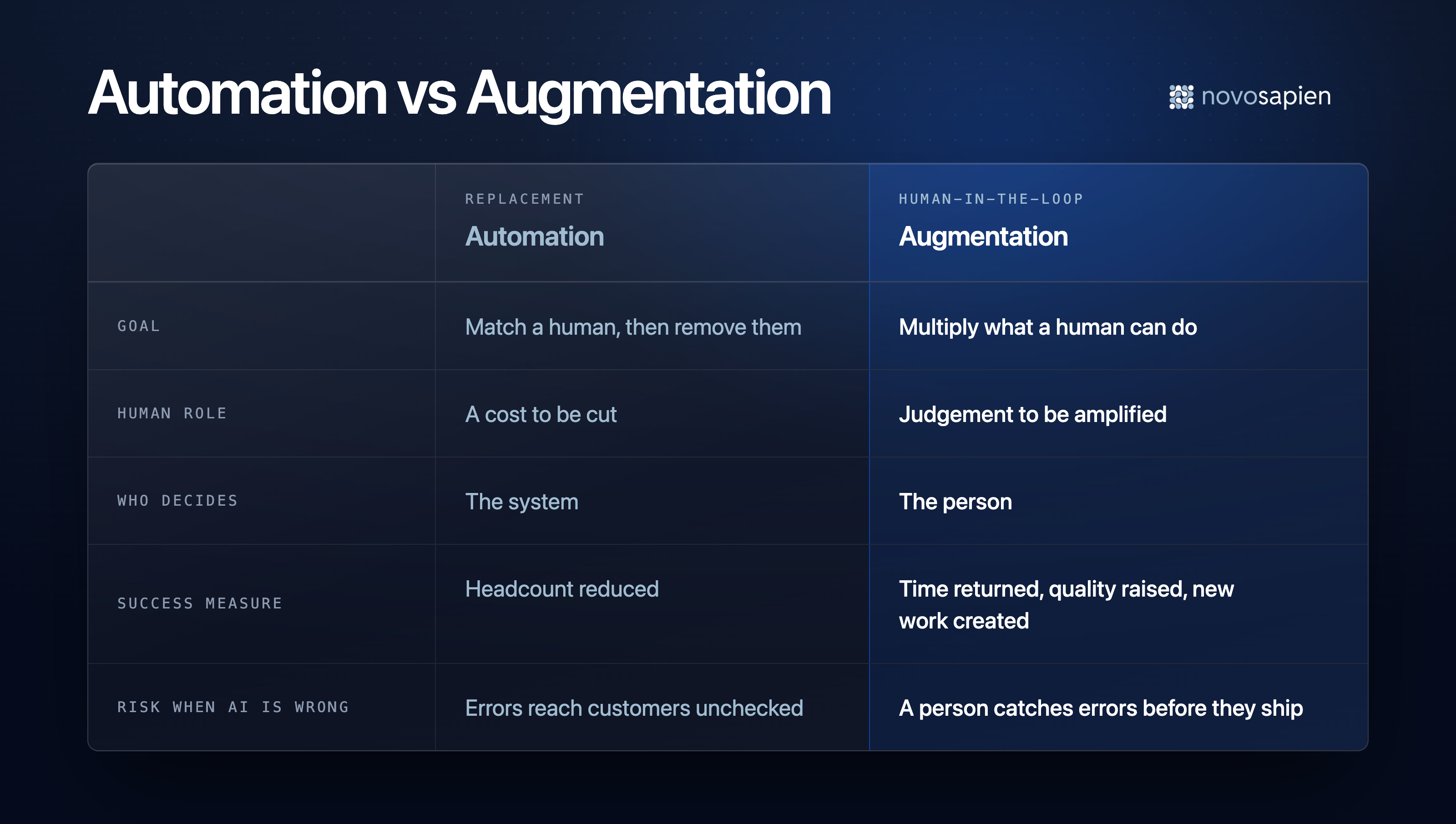
Why humans stay in the loop
AI is genuinely powerful, but it is not infallible. Acemoglu notes that when AI "hallucinates" it lacks the human filters that separate a promising idea from a dangerous one. That is why, at Novosapien, human oversight is a permanent part of every AI workforce we build, not a temporary stage before full automation.
The idea is not new. In 1960, computing pioneer JCR Licklider described the goal in his paper Man-Computer Symbiosis: humans and computers coupled so closely that the partnership would "think as no human brain has ever thought". Today's agentic AI finally makes that practical.
What Does the Data Say About AI and Jobs in 2026?
The research points one way: people prefer working with AI rather than being replaced by it, they already use it that way, and the market rewards those who do.
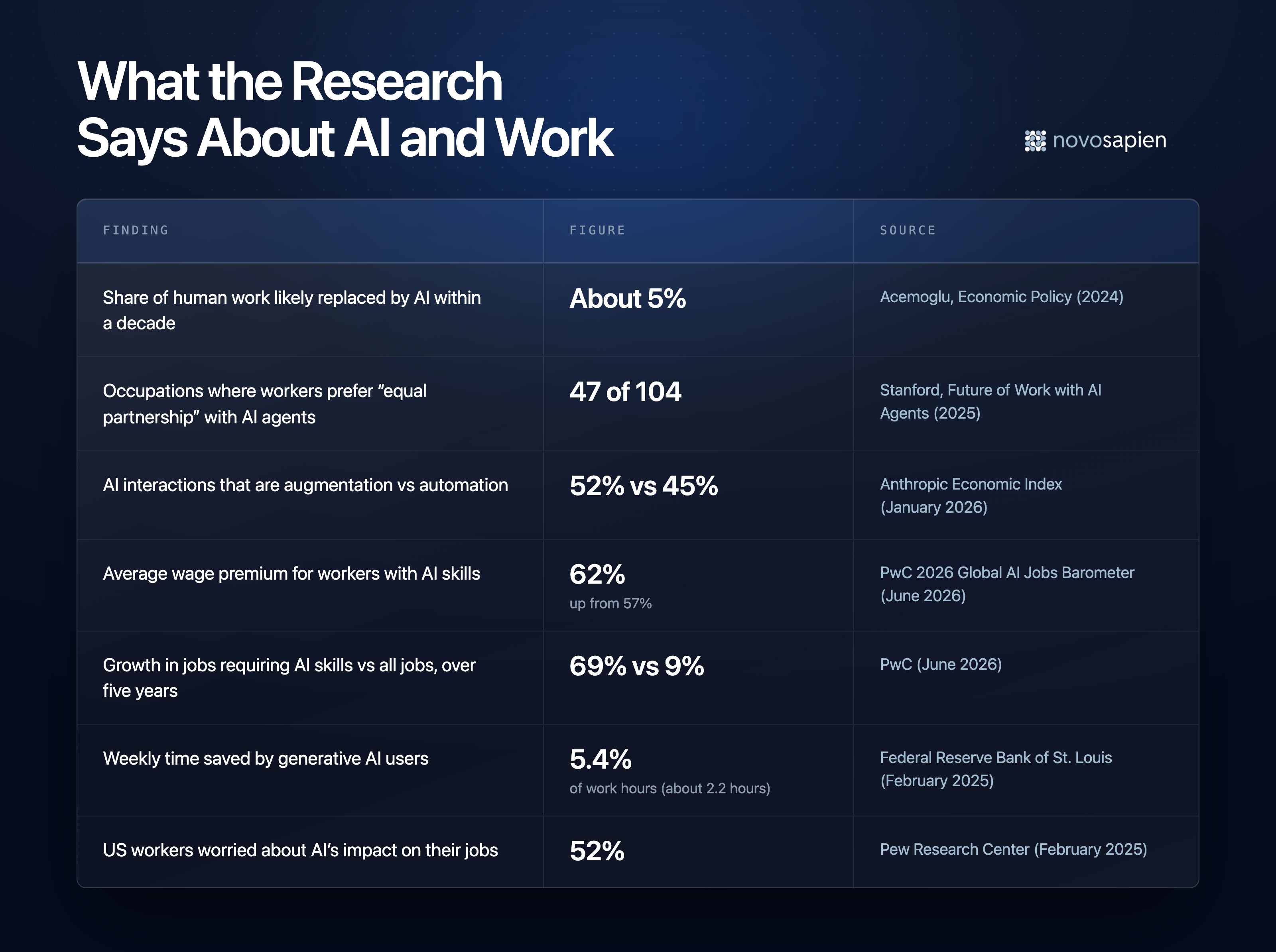
Workers want partnership, not replacement
Stanford's study introduced a five-level Human Agency Scale, from H1 (no human involvement) to H5 (human essential). The middle level, H3 or equal partnership, was the dominant preference across the occupations studied. Workers also consistently wanted more human involvement than AI experts judged necessary.
Augmentation is already how people use AI
The Anthropic Economic Index tracks real conversations with Claude. Its January 2026 report found augmentation (where people iterate, learn and check work with AI) narrowly ahead of automation (where AI completes a task with minimal back-and-forth).
The market pays for AI fluency
PwC's 2026 Barometer analysed more than a billion job adverts across 27 countries. It found that roles where AI takes on routine work and people focus on complex work are growing twice as fast as roles where AI takes on the complex work, with 42% higher wage growth since 2021 (PwC global findings). The people learning to work with AI are being paid more, not shown the door.
How Much Time Can AI Save You?
About 2.2 hours a week for the average generative AI user, or roughly 100 hours over a working year. The Federal Reserve Bank of St. Louis found users saved 5.4% of their working hours. Heavier users save more: a third of daily users reported saving four hours or more a week (St. Louis Fed, October 2025).
That matters because most knowledge workers are drowning. Microsoft's Work Trend Index (June 2025) found the average worker receives 117 emails and 153 Teams messages a day, around 40% check email before 6am, and 48% say their work feels chaotic and fragmented. Microsoft calls it the "infinite workday".
Why time, not productivity, is the real return
Productivity is usually measured as more output per hour. But the more valuable outcome of augmentation is what people do with the hours AI gives back:
- Higher-value work: the strategy, product idea or client relationship that never gets enough attention.
- New skills and creation: building, experimenting and learning, rather than processing.
- Life outside work: time with family, health and rest, which sustains everything else.
The catch: saved time disappears unless you plan for it
The St. Louis Fed researchers note that some saved time is simply absorbed into the working day rather than turned into new output. Freed hours fill up with more meetings unless someone decides where they go. The organisations that benefit most redesign workflows so the time is deliberately redirected.
How to Start Using Human-in-the-Loop AI at Work
Start with one repetitive workflow, keep a human sign-off step, and decide in advance where the saved time goes. Here is a six-step approach we recommend to teams beginning with AI augmentation:
- Audit one week of tasks. List every recurring task your team does between Monday and Friday.
- Set the autonomy slider for each task. Mark each as Hand Off (the agent runs it), Share (the agent drafts, a person finishes) or Keep (human only).
- Automate one Hand Off task first. Pick the most tedious, lowest-risk task and put it into production this week.
- Keep human verification. Anything that leaves the organisation, such as client emails, figures or commitments, gets checked by a person first.
- Plan the time dividend. Block the freed hours in calendars for specific higher-value work before meetings claim them.
- Measure outcomes, not activity. Track hours returned and what they were used for, not how many AI licences are switched on.
Example: turning meetings into finished work
Meetings are one of the easiest places to start. A two-tool workflow pairs an AI meeting notepad with a large language model (LLM) such as Claude or ChatGPT:
- Capture the meeting. Use an AI notepad such as Granola, which transcribes calls on Zoom, Google Meet, Microsoft Teams and Webex without a bot joining, and merges the transcript with the notes you jot down.
- Synthesise with an LLM. Granola's MCP connection lets assistants like Claude and ChatGPT read your meeting notes directly. Ask for a summary of decisions, a to-do list grouped by owner and a follow-up email for each attendee.
- Review and send. A person checks names, numbers and tone before anything goes out.
A simple prompt to adapt:
Below are my notes and the transcript from [meeting name], attended by
[names and roles]. Produce:
1. A five-line summary of decisions made.
2. A to-do list grouped by owner, with due dates where mentioned.
3. A follow-up email draft for each external attendee, in UK English.
4. Open questions to raise next time.
Flag anything you are unsure about rather than guessing.
Always tell participants you are recording. Under UK GDPR it is often a legal requirement, and it is good practice everywhere.
Frequently Asked Questions
Will AI take my job?
For most people, AI is more likely to change the tasks in a job than remove the job entirely. Economist Daron Acemoglu estimates around 5% of human work will be replaced by AI within a decade. People who learn to work with AI are currently earning a 62% wage premium, according to PwC (2026).
What is the difference between AI automation and AI augmentation?
AI automation means a system completes a task end to end with no human involvement. AI augmentation means AI does the heavy lifting, such as research, drafting or summarising, while a person directs the work, checks the output and makes the final decision.
What does "human in the loop" mean in AI?
Human in the loop means a person stays involved at key points in an AI workflow: setting the goal, reviewing the output and approving decisions with real consequences. It reduces errors from AI mistakes and keeps accountability with people.
How much time does AI actually save?
The Federal Reserve Bank of St. Louis found that generative AI users save about 5.4% of their working hours, roughly 2.2 hours a week or about 100 hours a year. Daily users save more, with a third reporting four or more hours a week.
Do workers want AI agents at work?
Yes, but as partners. Stanford's 2025 Future of Work with AI Agents study found "equal partnership" between people and AI was the preferred model in 47 of 104 occupations, and workers generally wanted more human involvement than experts thought necessary.
What is pro-worker AI?
Pro-worker AI is a term used by economist Daron Acemoglu for AI designed to make people better at their jobs and create new skills, rather than to replace them. An example is a classroom tool that identifies which students are struggling so the teacher can regroup and target them.
What is an agentic AI workforce?
An agentic AI workforce is a team of AI agents that carry out multi-step business processes, such as research, outreach, content creation or sales follow-up, within set guardrails. At Novosapien, every AI workforce keeps people in the loop to direct the work and approve what matters.
Conclusion: Stay Human, Get Your Time Back
The question isn't whether AI will replace workers. It's whether we build AI that makes people better at their work, or AI that tries to imitate them. The evidence from economists, researchers and the jobs market favours augmentation. Keep humans in the loop, give the repetitive work to agents, and decide on purpose what to do with the hours you get back.
Related Articles

First AI Startup? Why the Model Is the Easy Part
Most AI pilots never reach production. Novosapien co-founder George Westbrook shares three lessons for starting your first AI company properly.

Why We Finally Trust Autonomous Code Generation
How externalised state, fresh-context loops, and a strict rule hierarchy turned autonomous AI coding from a liability into a reliable production workflow.