Chatbot vs AI Content Team: What Is the Difference?
A chatbot writes when you prompt it. An AI content workforce plans, produces, publishes and learns. See the difference and when each one fits.


A chatbot writes when you prompt it. An AI content workforce plans, produces, publishes and learns. See the difference and when each one fits.
Why a Chatbot Is Not a Content Team
A chatbot is not a content team because it only works when you prompt it, and everything around the draft stays with you.
A chatbot can write text. A content team decides what to say, writes it, designs it, gets it approved, publishes it and learns from the results.
The Content Workforce from Novosapien is built to do the second job.
Key takeaways
- A chatbot waits to be asked. A content workforce proposes what to post.
- Writing is one step of content marketing. Strategy, design, review, publishing and measurement are the rest.
- With a chatbot, you remain the workforce. With the Content Workforce, you direct and approve.
- Chatbots are still useful for one-off tasks and brainstorming. Consistent, multi-platform content needs a team.
Can ChatGPT or another chatbot replace a content team?
Not on its own. General-purpose chatbots are good at drafting, and many marketers use them every day.
But a draft is the smallest part of the job.
Deciding what to post, keeping one voice across every piece, designing the visuals, collecting approval, publishing and reviewing performance all still land on a person.
That is why teams who adopt a chatbot often find their writing got faster while their workload barely moved. They are still the ones running the process.
What does a content team actually do?
A content team covers six jobs:
- Decides what to post and why
- Writes the content in the brand's voice
- Designs the visuals, such as carousels and infographics
- Reviews and revises until the work is right
- Publishes to the right platforms at the right time
- Learns from engagement and adjusts the plan
A chatbot helps with job two. The Content Workforce covers all six, with a person approving the work at the points that matter.
Where does the chatbot approach break down?
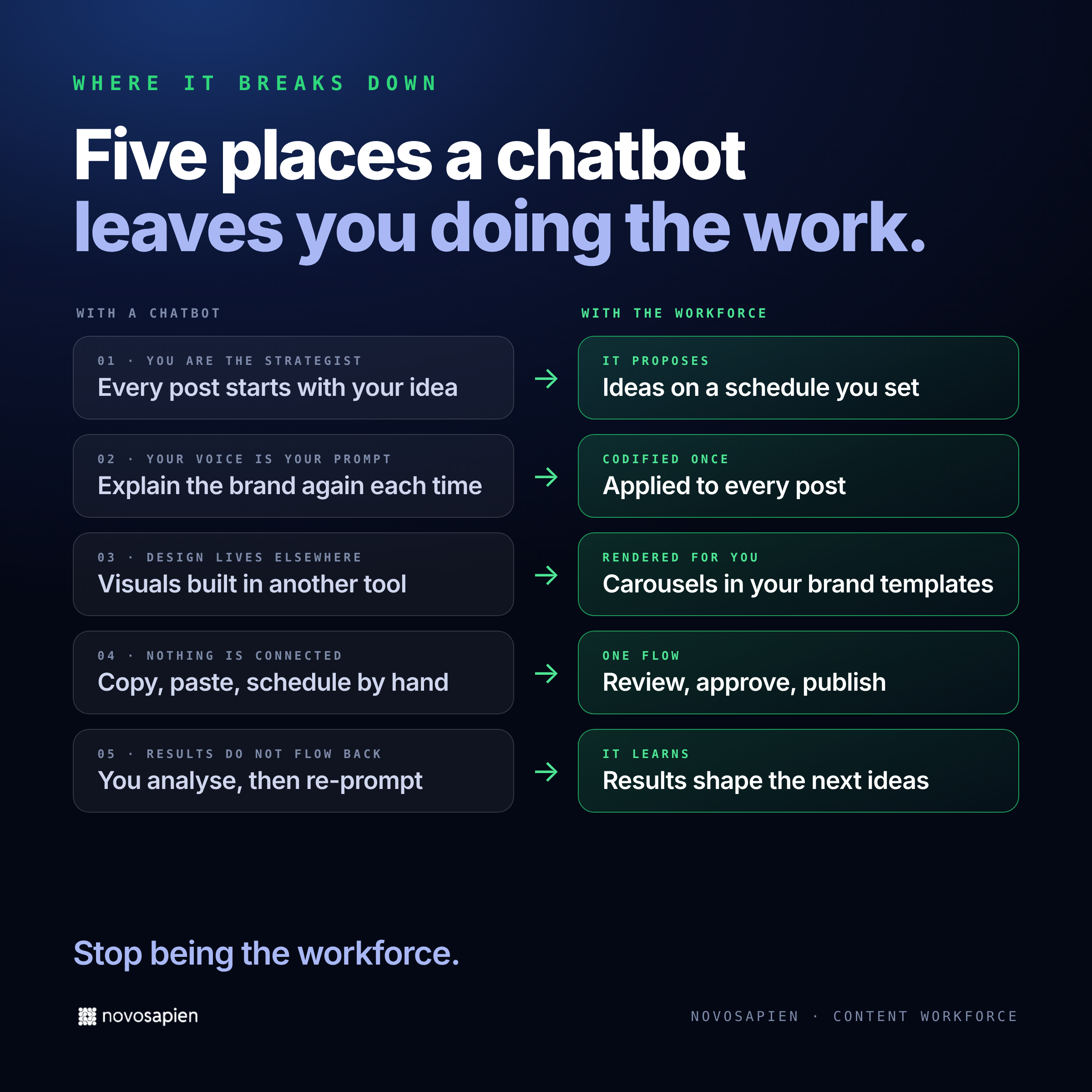
- You are the strategist. A chatbot does not propose anything. Every post starts with your idea and your prompt.
- Your voice depends on your prompt. Unless you explain the brand again each time, the tone drifts. The Content Workforce codifies your manifesto, style and pillars once and applies them to every piece.
- Design lives somewhere else. A text answer still needs a carousel, an image or an infographic built in another tool.
- Nothing is connected. Review, approval, scheduling and publishing happen by copying and pasting between tools.
- Results do not flow back. Learning from what performed means you analyse the numbers and write a better prompt yourself.
Chatbot vs Content Workforce: how they compare
When should you use a chatbot, and when a workforce?
Use a chatbot for a quick draft, a brainstorm or a one-off question. It is flexible and fast for work that you drive yourself.
Use a content workforce when you need consistent, multi-platform content, when you run several brands, or when your next post would need another hire. The two are not rivals. A chatbot is a tool you operate.
A workforce is a team you direct.
What does working with the Content Workforce look like?
On the schedule you choose, the workforce brings you a shortlist of scored post and campaign ideas.
You pick the ones you want. Specialised agent teams write the content and build the visuals. You comment, request changes and approve. Approved posts are published, and the results feed the next round of ideas.
You can do all of this in the app or by messaging Nova, the conversational assistant, on web chat or WhatsApp.
For a full walkthrough, read The Content Workforce: Content Output Without the Headcount Ceiling.
Frequently asked questions
Why is a chatbot not enough for content marketing? A chatbot produces text when you prompt it, but content marketing is a workflow of planning, writing, design, approval, publishing and measurement. A chatbot covers only the writing, so you still run every other step yourself.
Can ChatGPT replace a content team? Not by itself. ChatGPT and similar chatbots can draft quickly, but they do not propose what to post, design carousels, manage approvals or publish. A content workforce is built to cover that whole lifecycle.
What is the difference between an AI content workforce and an AI writing tool? A writing tool helps a person write faster. An AI content workforce is a team of specialised agents that proposes ideas, writes, designs, publishes and learns, with the client approving each step.
Can I use a chatbot alongside the Content Workforce? Yes. Chatbots remain useful for ad hoc questions and brainstorming. The Content Workforce handles the recurring production of on-brand content across platforms.
Does the Content Workforce keep my brand voice consistent? Yes. Your manifesto, style guidelines, content pillars and audiences are written down once and used for every piece. Each brand also has its own isolated workspace.
Who stays in control? You do. The workforce proposes and produces, but nothing is published without your approval, and every revision is saved as a version.
Stop being the workforce
If you are still the strategist, writer, designer and scheduler behind every post, a faster chatbot will not change that.
Related Articles

ChatGPT vs an AI Content Workforce: We Ran a Blind Test on the Same Brief
In our test, the AI content workforce produced the stronger article, before and after feedback. ChatGPT wrote a clear, balanced overview with no data. The Novosapien Content Workforce wrote a specific, commercially grounded argument with a worked financial example, a memorable framework and a hook built on a real moment in an agency owner's week.

AI Content Workforce: Scale Content Without Hiring
The Content Workforce is a team of AI agents that proposes, writes, designs and publishes your content. You stay in control and approve everything.