ChatGPT vs an AI Content Workforce: We Ran a Blind Test on the Same Brief
In our test, the AI content workforce produced the stronger article, before and after feedback. ChatGPT wrote a clear, balanced overview with no data. The Novosapien Content Workforce wrote a specific, commercially grounded argument with a worked financial example, a memorable framework and a hook built on a real moment in an agency owner's week.


Key takeaways
- We gave ChatGPT and the Novosapien Content Workforce the same brief and a similar outline for a B2B article on agency growth.
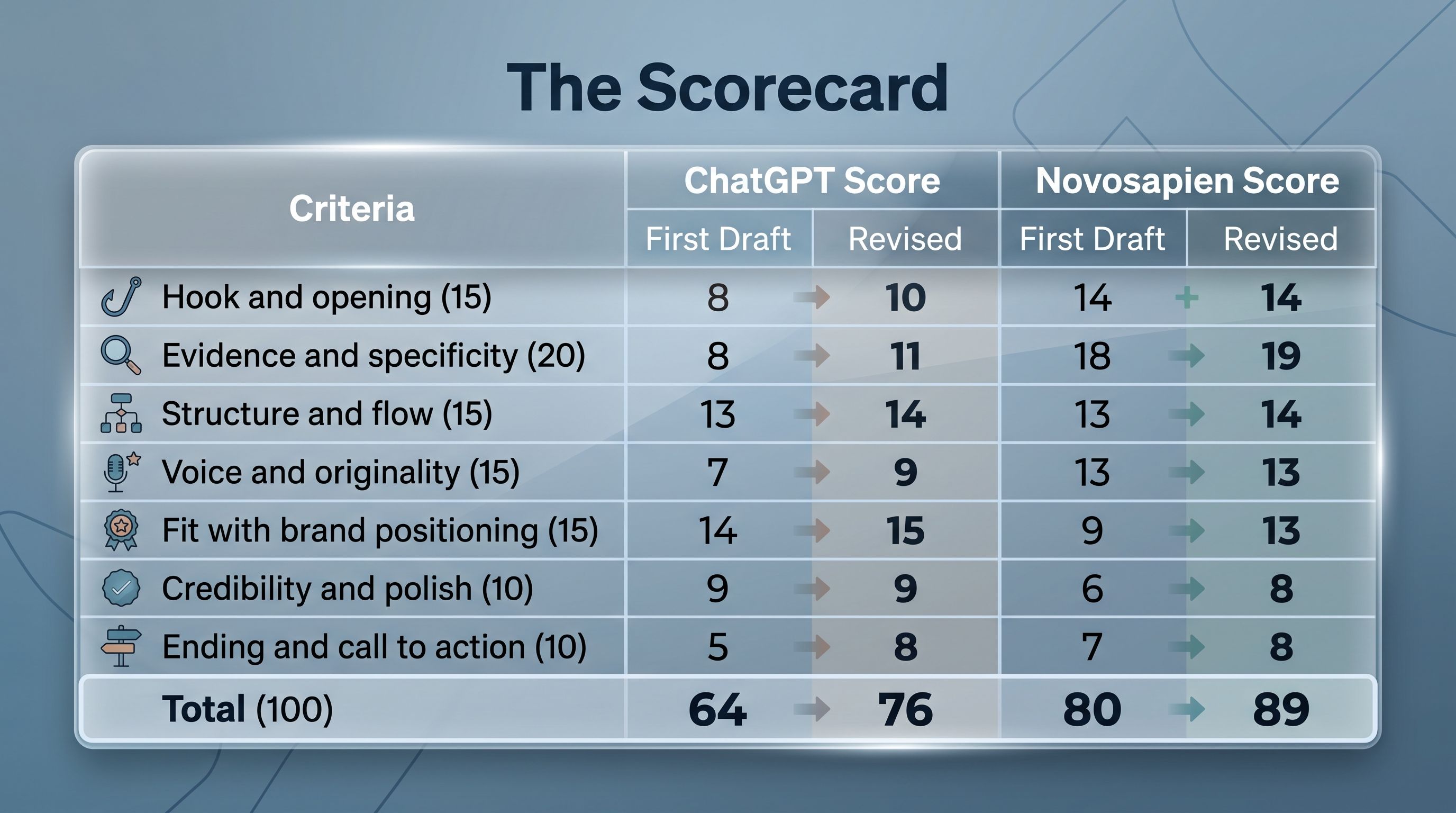
- Claude Opus 5.5 scored both first drafts blind across seven weighted criteria: Content Workforce 80, ChatGPT 64.
- Both tools then received the same feedback and revised once: Content Workforce 89, ChatGPT 76.
- The biggest gap was evidence and specificity (19 vs 11), the one area feedback could not close.
- ChatGPT won brand fit (15 vs 13) and polish (9 vs 8), and tied on the ending (8 each).
- Feedback fixed ChatGPT's tone and structure. It could not supply research the first draft never did.
- The difference comes from structure: ChatGPT is a single writing tool, while a content workforce runs research, strategy, writing and feedback as a team.
Is ChatGPT or an AI content workforce better for B2B content?
In our test, the AI content workforce produced the stronger article, before and after feedback.
ChatGPT wrote a clear, balanced overview with no data. The Novosapien Content Workforce wrote a specific, commercially grounded argument with a worked financial example, a memorable framework and a hook built on a real moment in an agency owner's week.
A blind judge scored the first drafts 80 vs 64. After both tools received the same feedback, the revisions scored 89 vs 76.
How we ran the test
- Brief: The Agency Growth Ceiling: Why Hiring More People Isn't Always the Answer
- Audience: marketing and B2B agency owners and leaders
- Inputs: identical brief, similar outline
- Outputs: used as produced, with no human rewriting
- Judge: Claude Opus 5.5, told only that there were two articles on the same brief, not which tool wrote which
- Revision: the judge's notes went back to both tools for one revision each; both revisions were scored on the same criteria, after the authors were known
- Criteria: seven criteria weighted to 100 points
The results
Where the Content Workforce pulled ahead
A hook built on a real moment
ChatGPT opened with a general statement about growth being a good problem to have. The workforce opened with a scene: a £15,000 retainer signed on a Tuesday morning, a delivery team already at 95% capacity, and the knot in the stomach that follows. Specific moments earn attention; general statements don't.
Evidence instead of assertion
The ChatGPT article had no figures or sources. The workforce article walked through the real cost of a £55,000 hire: an £11,000 recruiter fee, months of ramp-up at low billable capacity, and on-costs pushing the seat past £70,000, turning a projected 60% margin into under 35%. It also applied Brooks's communication formula, n(n - 1) / 2, to show how 8 people share 28 communication lines while 35 people share 595.
After feedback, the workforce named its sources, including The Wow Company's BenchPress survey, SPI Research's 2026 benchmark and Alto Accounting. ChatGPT's revision added a step-by-step reporting workflow but still no figures or sources, so its evidence score moved from 8 to 11 against the workforce's 19.
A voice written for buyers
The judge flagged the ChatGPT article for hedging, short one-line paragraphs and the recognisable "It's not X. It's Y." cadence. The workforce article used the language agency owners use about their own business: margin, utilisation, ramp time and valuation multiples.
Where ChatGPT came out ahead
After revision, ChatGPT won two categories and tied a third. On brand fit it scored 15 vs 13: its revision kept human approval and judgement in every section, while the workforce draft had leaned on words like "autonomous" until revision brought people back in. On polish it scored 9 vs 8, because it made few claims that needed sources, while the workforce still has a few uncited figures. On the ending both scored 8, and ChatGPT's revised closing line is one of the best in either article.
Both points are valid. Both are also the kind of issue a human editor fixes in minutes. Rewriting a generic article into a specific one takes far longer.
What can feedback fix in ChatGPT content?
Feedback fixed a lot. ChatGPT's revision dropped most AI clichés, added a worked reporting example, tightened its brand fit and gained 12 points. What it could not fix was the missing research: no figures, benchmarks or sources appeared, and evidence moved only from 8 to 11. ChatGPT gained by removing faults. The workforce gained by adding substance, and finished 13 points ahead.
Why does ChatGPT content sound generic?
A general-purpose chatbot answers a single prompt in a single pass. Without research, brand context or performance data, it produces the most probable article on the topic, which is close to every other article on the topic. Prompting harder helps at the margins, but it does not add research the model never did or a brand voice it was never given.
What is an AI content workforce?
An AI content workforce is a team of specialist AI Employees that runs the full content function, not just the writing. In the Novosapien Content Workforce, that means:
- Codify: your brand kit, pillars and personas become the rules behind every piece
- Ideas: researchers scan competitors, trends and news, then score and rank ideas
- Create: writers and designers produce posts, articles, carousels and video in your voice
- Publish: content goes to LinkedIn and X, with more channels rolling out, after your approval
- Compound: performance data flows back so each cycle improves the next
Your people set direction and approve the work. The workforce does the production.
When is ChatGPT enough?
ChatGPT is a good fit for one-off drafts, brainstorming, summaries and quick rewrites where a person will shape the result heavily. An AI content workforce fits when you need consistent, on-brand, research-led content across several channels every week, without adding headcount.
FAQ
How was the test judged? Both first drafts were given to Claude Opus 5.5 without labels. It scored each against seven weighted criteria totalling 100 points and chose the stronger article before the authors were revealed. Both tools then revised once using the judge's notes, and both revisions were scored on the same criteria.
Did a human edit either article? No. Both first drafts were scored exactly as produced. Each tool then revised its own draft once using the same feedback.
How does an AI content workforce stay on brand? Your brand voice, style and visual identity are codified once and govern every piece. Performance data and feedback flow back so the voice sharpens each cycle.
Can I review content before it is published? Yes. You set the approval threshold, and nothing publishes until you approve it.
How is the Content Workforce different from Jasper, Copy.ai or ChatGPT? Those are writing tools. The Content Workforce covers the whole content function: research, idea scoring, drafting in your voice, visual design, publishing and learning from performance.
See it on your brand
Speak to us about the Content Workforce: novosapien.ai/contact
Related Articles

Chatbot vs AI Content Team: What Is the Difference?
A chatbot writes when you prompt it. An AI content workforce plans, produces, publishes and learns. See the difference and when each one fits.

AI Content Workforce: Scale Content Without Hiring
The Content Workforce is a team of AI agents that proposes, writes, designs and publishes your content. You stay in control and approve everything.