



That one sentence is the answer most people are searching for.
The rest of this report is the evidence behind it.
In 2026, four pieces of research tell the same story from different angles. Deloitte's State of AI in the Enterprise surveyed 3,235 leaders across 24 countries. BCG's Applied AI Index 2026, The Formula for Agentic AI Value surveyed 1,330 CxOs across more than 20 sectors. McKinsey's The State of AI in 2026: On the Road to ROI gathered 1,719 responses from 97 countries. And the LSE primer Behavioural Science Meets AI by Annabel Gillard, Anna King, Isabel Kaldor and Muskaan Mehlawat maps where humans sit in the loop.
This is the Novosapien view of what that research means for any business deciding how to put AI agents to work.
Agentic AI in 2026: the numbers at a glance
- 74% of companies plan to use agentic AI at least moderately within two years, up from 23% today (Deloitte).
- 21% of companies have a mature governance model for autonomous agents (Deloitte).
- 22% of all AI value now comes from agentic AI, projected to reach 39% by 2030 (BCG).
- 42% of companies expect agents to act autonomously by 2030, yet only 5% have the controls in place (BCG).
- 3x: companies with all six agent controls in place generate three times the agentic AI value (BCG).
- 40% of large organisations are now scaling AI agents, up from 27% a year ago (McKinsey).
- 80% of people say AI improves their productivity, but only 37% of organisations see any EBIT impact (McKinsey).
- 89% of companies expect AI to create new work, against 11% who expect it mainly to replace jobs (BCG).
What is agentic AI?
Agentic AI is a class of AI system that acts, not just answers.
Where a chatbot responds to a prompt, an AI agent is given an objective and works towards it across several steps, deciding what to do next along the way.
The research houses define it in almost the same terms.
McKinsey defines AI agents as AI systems based on foundation models that act in the real world and can autonomously plan and execute multiple steps in a workflow.
Deloitte describes agents that can set goals, reason through multi-step tasks, use tools and APIs, and coordinate work with people or with other agents. In Deloitte's words, this shift turns AI from a source of information into a system that performs work.
The four things that make AI "agentic"
- Goals, not prompts. The agent is told what outcome to achieve, such as "rebook this passenger" or "qualify this lead", rather than what text to write.
- Planning and reasoning. It breaks the goal into steps and decides the order, adjusting when a step fails.
- Tool use and action. It calls software, APIs, databases and other agents to do real work: sending messages, updating records, making purchases or changing systems.
- Memory and context. It carries information between steps and tasks. BCG ranks memory and context handling as the single most important control for agentic value, at 32% of relative importance (BCG).
Agentic AI vs generative AI vs chatbots
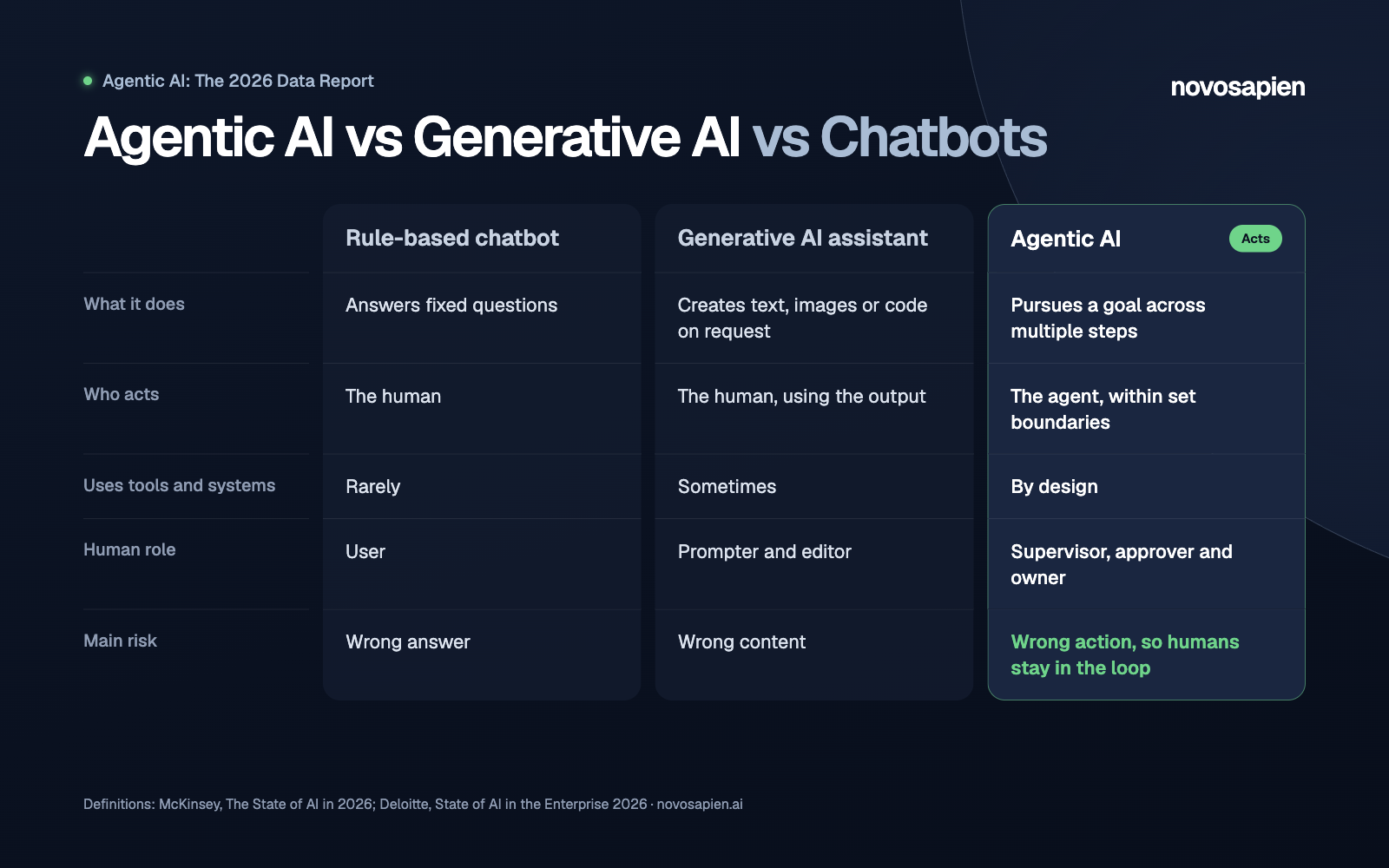
1. Rule-based chatbot
- What it does: Answers fixed questions
- Who acts: The human
- Uses tools and systems: Rarely
- Human role: User
- Main risk: Wrong answer
2. Generative AI assistant
- What it does: Creates text, images or code on request
- Who acts: The human, using the output
- Uses tools and systems: Sometimes
- Human role: Prompter and editor
- Main risk: Wrong content
3. Agentic AI
- What it does: Pursues a goal across multiple steps
- Who acts: The agent, within set boundaries
- Uses tools and systems: By design
- Human role: Supervisor, approver and owner
- Main risk: Wrong action
That last row is the crucial one. Deloitte notes that, unlike conventional AI that makes recommendations for humans to act on, agents take actions directly, which is why the governance conversation changes completely (Deloitte).
Agentic AI is a ladder, not a switch
Autonomy is earned in stages. BCG describes a global outsourcing provider that built its operating model as a ladder: insights (AI diagnoses the work), then copilot (AI assists employees), then autopilot (agents run tasks end to end). Crucially, autonomy was set at the process level, which defines where decisions occur and when a human must be involved (BCG). Pilots on that model improved conversion rates by up to 40%.
How fast is agentic AI being adopted?
Agentic AI is moving from experiment to standard operating practice faster than any previous wave of enterprise AI.
Deloitte expects usage to roughly triple in two years.
Deloitte: from 23% to 74% in two years
- 23% of companies use agentic AI at least moderately today. Within two years that rises to 74%, with 23% using it extensively and 5% fully integrating it as a core part of operations (Deloitte).
- 85% of companies expect to customise agents to fit the unique needs of their business (Deloitte). Off-the-shelf agents are the starting point, not the destination.
- Agentic AI is expected to have the biggest impact in customer support, followed by supply chain, R&D, knowledge management and cybersecurity.
- For comparison, physical AI (robots, drones, autonomous machinery) grows from 58% to 80% over the same period. Software agents scale faster because they avoid hardware cost, long build cycles and safety certification.
McKinsey: large enterprises are pulling away
- 88% of respondents report regular AI use in at least one business function, and 44% say AI is now scaling across their enterprise, up from 38% (McKinsey).
- 40% of organisations with revenue above $1 billion are scaling AI agents, up from 27% a year earlier. Smaller organisations are flat at 22%.
- About two in ten organisations are scaling AI agents across the enterprise, and a similar share are scaling software coding agents (31% at large enterprises).
- 32% of organisations have decided against buying at least one software product because they could build it in-house with agentic coding tools. That figure reaches 41% in technology and 39% in healthcare.
- Agents are most often scaled in IT, knowledge management and software engineering. In technology companies, 31% are scaling agents in software engineering alone.
BCG: agentic is becoming the main source of AI value
- Agentic AI accounted for 17% of AI value in 2025 and 22% in 2026. BCG projects 39% by 2030, when it overtakes non-agentic AI as the largest single source of AI value (BCG).
- Share of companies with agentic AI in production by sector: technology 76%, telecom 62%, banking 61%, machinery 55%, aerospace 52%, biopharma 50%, retail 49%, insurance 48%.
- 44% of future-built companies already realise full value from agentic AI, compared with 2% of laggards.
What this means
The gap is no longer between companies that use AI and those that don't.
Nearly all do.
The gap is between companies that let AI agents do real, end-to-end work and those still using AI as a smarter search box. BCG found future-built companies are three times as likely to use AI for substantial multistep work as for quick one-off questions (78% versus 25%).
Does agentic AI deliver ROI? What the data says
Yes, but only for companies that redesign work around it. Value from AI is real and widening, yet it is concentrated in a small group that treats AI as an operating model change rather than a tool rollout.
The individual vs enterprise gap
McKinsey captures the central paradox of 2026. 80% of respondents say AI has improved their own productivity and 50% say it helps them make better decisions. Yet only 37% report any EBIT impact at enterprise level, unchanged from 2025. McKinsey's AI high performers, who attribute 5% or more of EBIT to AI, remain flat at about 6% of respondents.
Deloitte sees the same pattern. 66% of organisations report productivity and efficiency gains, but only 20% are growing revenue through AI, while 74% hope to. Encouragingly, 25% of leaders now say AI is having a transformative effect, more than double the 12% of a year ago.
The value leaders vs the laggards
BCG puts hard numbers on the divide. Almost 50% of companies now generate measurable value from AI: 7.5% are "future-built" (up from 5% in 2025) and 41% are scaling.
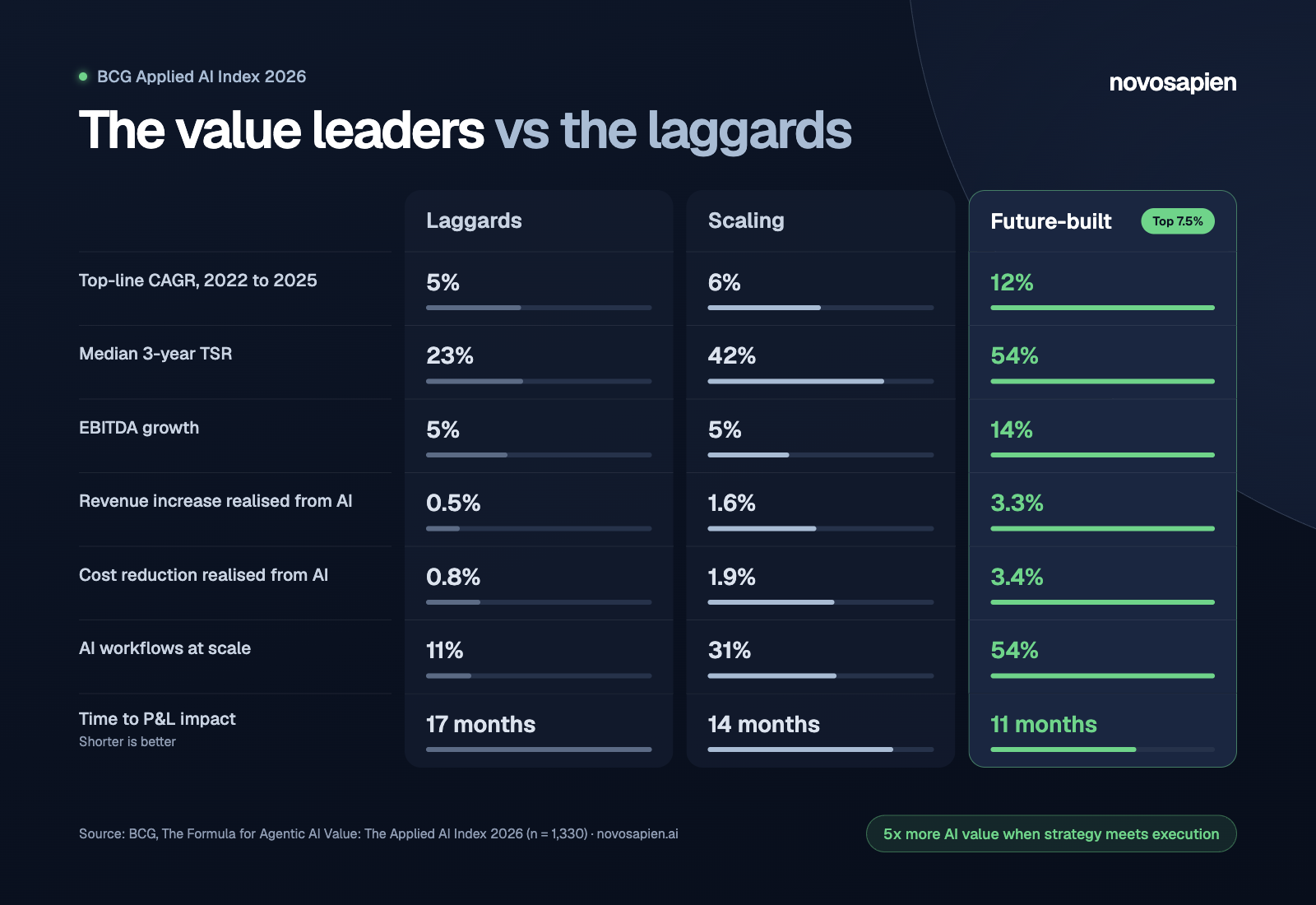
Key metrics from the BCG Applied AI Index 2026 (n = 1,330):
- Top-line CAGR (2022 to 2025): 12% for Future-built vs. 6% for Scaling and 5% for Laggards
- Median 3-year TSR: 54% for Future-built vs. 42% for Scaling and 23% for Laggards
- EBITDA growth: 14% for Future-built vs. 5% for Scaling and 5% for Laggards
- Revenue increase realised from AI: 3.3% for Future-built vs. 1.6% for Scaling and 0.5% for Laggards
- Cost reduction realised from AI: 3.4% for Future-built vs. 1.9% for Scaling and 0.8% for Laggards
- AI workflows at scale: 54% for Future-built vs. 31% for Scaling and 11% for Laggards
- Time to P&L impact: 11 months for Future-built vs. 14 months for Scaling and 17 months for Laggards
Source: BCG, The Formula for Agentic AI Value, n = 1,330.
When strategic clarity meets applied AI maturity, companies unlock five times as much AI value: 4.5% of revenue, against 0.9% when both are missing.
Where the money is going
- AI spending has more than tripled, from about 1% of revenue to 3.3%, while enterprise IT budgets stayed roughly flat (BCG).
- More than 80% of AI spending now sits outside enterprise IT, in operations, products, talent and governance.
- 84% of organisations are increasing AI investment and 78% of leaders report greater confidence in the technology (Deloitte).
- 60% expect to increase AI investment next year, and 28% already spend more than 10% of their ICT budget on AI (McKinsey).
Tokenomics: agentic AI is not too cheap to meter
Agents consume far more compute than chat. About 20% of organisations say AI operating costs, including tokens, have constrained their AI use.
McKinsey's Michael Chui notes that even as per-token prices fall, token consumption is rising faster (McKinsey). High performers report cost constraints on coding agents three times as often as others, because they use them hardest.
BCG's answer is to measure cost per successful outcome, not cost per token, including the human effort needed to review the work. 75% of future-built companies have made an explicit call on token spending, while 50% of laggards either grant access without tracking it or monitor spend without limits (BCG).
Agentic AI in action: real results
- Health insurer: three agentic AI solutions now handle about 60% of incoming call types, cutting average handling time by 35%. Projected savings: over $60 million in the first wave, $200 million run rate overall (BCG).
- Global resources company: an AI agent cut master data change requests from 68 steps to 3, clearing a six-month backlog across 10,000+ requests a year.
- Investment bank: fewer than ten high-value use cases, tracked straight to the P&L, targeting $500 million by 2027 and $1 billion by 2030.
- Air carrier: AI agents handle rebooking and rerouted bags, freeing human agents for complex cases (Deloitte).
Human in the loop: why agentic AI still needs people
The biggest risk in agentic AI is not that agents fail. It is that companies hand agents authority faster than they build the oversight to match. Both Deloitte and BCG measure this gap, and it is wide.
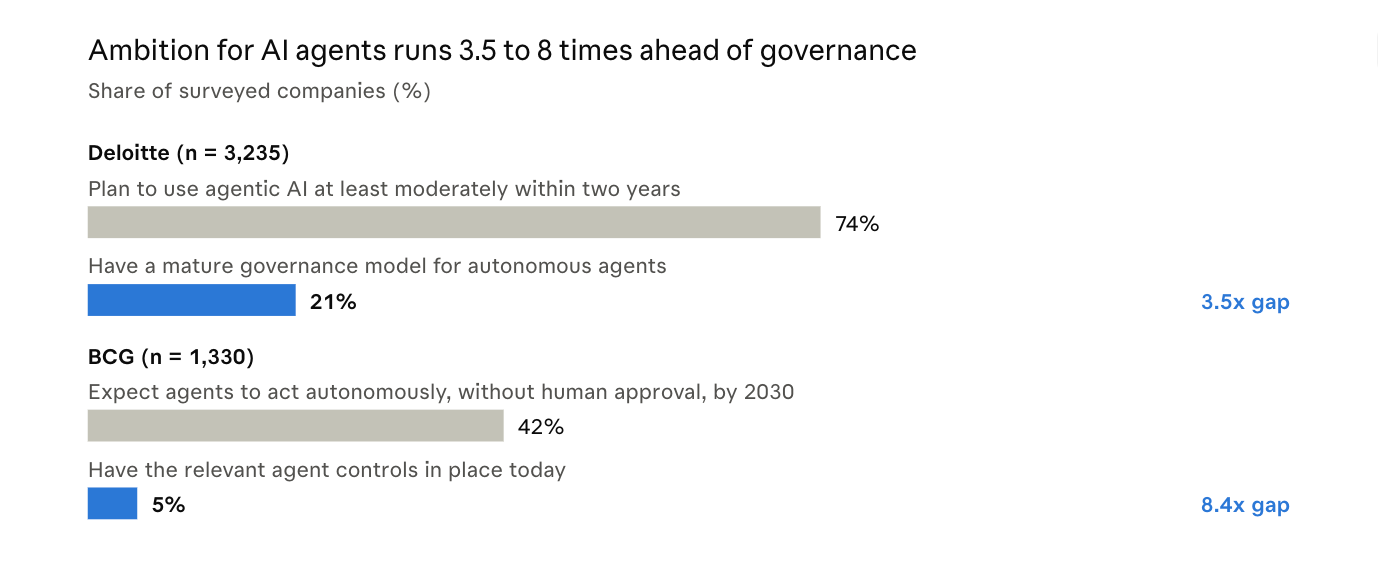
Deloitte calls it agents "scaling faster than the guardrails". BCG finds the gap even sharper once autonomy means acting without human approval.
What "human in the loop" actually means
Human in the loop (HITL) is a design choice that defines where a person must review, approve or override an AI system's output before it takes effect. It is not one setting.
The LSE primer Behavioural Science Meets AI maps a spectrum of six integration levels, from most to least autonomous:
- Fully automated: operates without human intervention, learning from its own experience (robotic process automation, self-driving cars).
- Semi-automated: supports human decisions but does not replace them (recommender systems, predictive analytics, chatbots).
- Assisted: provides analysis and recommendations while final decisions stay with humans (NLP, computer vision, speech recognition).
- Collaborative: works alongside humans in real time, offering live insights during interactive decisions (real-time bidding, collaborative robots).
- Advisory: offers suggestions, with decision-making remaining entirely human (business intelligence, market research).
- Dependent: relies on humans for its learning and improvement (supervised labelling, quality control).
Agentic AI deliberately moves work up this ladder. The question for every workflow is how far, and with which checkpoints.
The human-in-the-loop gate
Deloitte's interviews show agentic AI creates new human work before it removes any.
A former telecoms executive explained that staff will be watching agents, checking volume and quality metrics, and "being there to interact with them if they hit a human-in-the-loop gate" for accountability purposes (Deloitte).
McKinsey lists human-in-the-loop design as a core best practice of AI high performers: deciding how and when model outputs need human validation. High performers are also much more likely to actively mitigate unauthorised or unintended actions by AI, the defining risk of agents.
BCG's playbook is explicit about sequencing. Companies building foundations should keep humans in the loop as the final decision-maker and owner. Only once controls mature should they grant agents real autonomy in bounded domains (BCG).
The six agent controls that triple value
BCG found that governance is an accelerator, not a brake. Companies with all six controls in place enterprise-wide generate 1.8% of revenue from agentic AI, against 0.5% for those with one: more than three times as much. When controls are enterprise-wide rather than piloted, companies capture 3.6 times the agentic value (BCG).
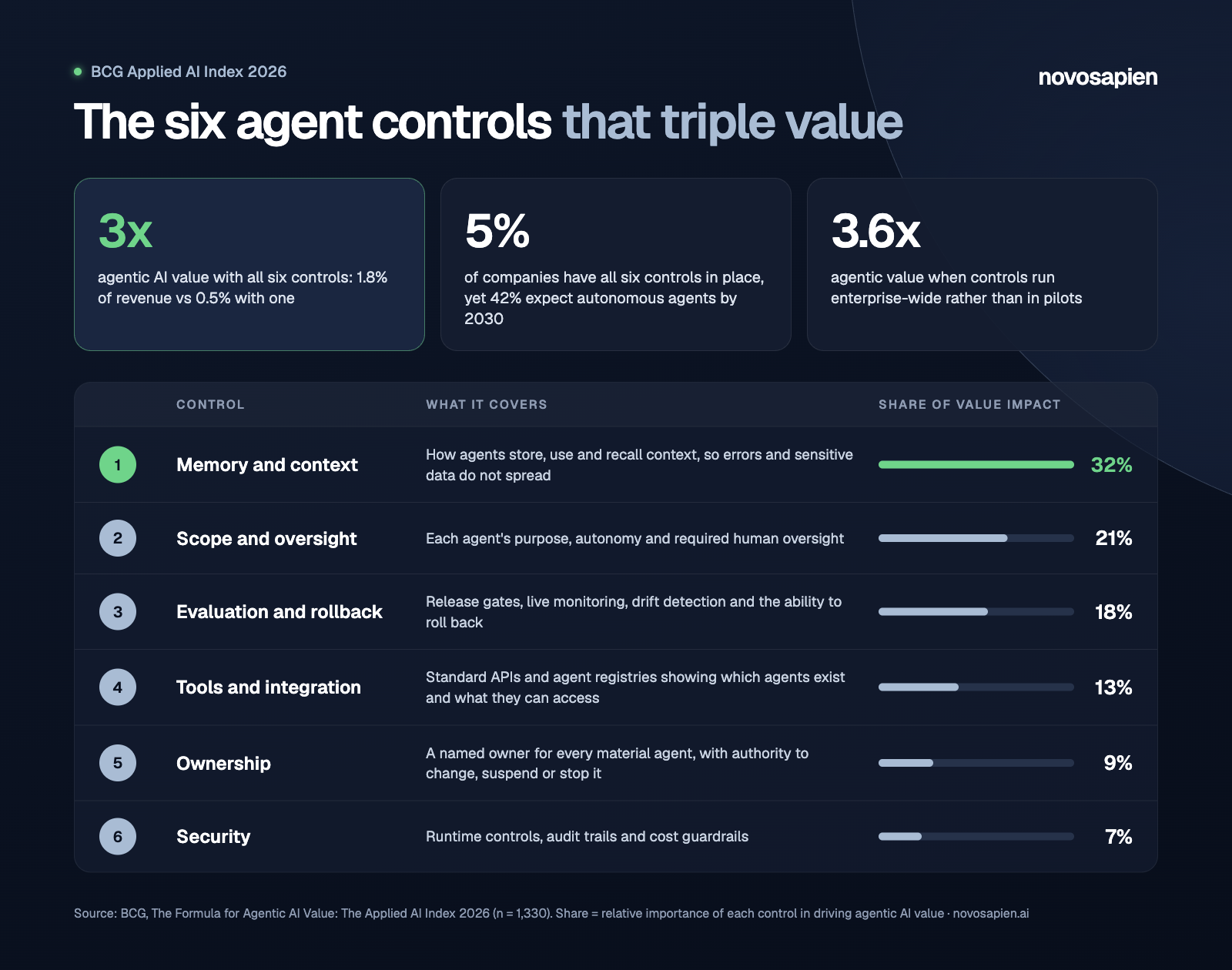
- Memory and context (32% of value impact): How agents store, use and recall context, so errors and sensitive data do not spread.
- Scope and oversight (21% of value impact): Each agent's purpose, autonomy and required human oversight.
- Evaluation and rollback (18% of value impact): Release gates, live monitoring, drift detection and the ability to roll back.
- Tools and integration (13% of value impact): Standard APIs and agent registries showing which agents exist and what they can access.
- Ownership (9% of value impact): A named owner for every material agent, with authority to change, suspend or stop it.
- Security (7% of value impact): Runtime controls, audit trails and cost guardrails.
BCG also warns of agent sprawl: duplicated agents, conflicting permissions, unclear ownership and monitoring gaps, with risks that compound at machine speed.
What leaders worry about most
According to Deloitte, the top AI risks are all governance problems: data privacy and security (73%), legal, IP and regulatory compliance (50%), governance capabilities and oversight (46%) and model quality, consistency and explainability (46%).
Deloitte's guidance is to define which decisions agents can make independently and which require human approval, backed by real-time monitoring and full audit trails.
The behavioural science of agentic AI
Agentic AI is a behaviour change programme disguised as a technology project. The data shows the tools are rarely what holds companies back. People's habits, trust and decision patterns are.
Adoption is a behavioural problem, not a licensing problem
- Worker access to sanctioned AI tools rose by 50% in a year, to around 60% of workers. Yet fewer than 60% of those with access use AI in their daily workflow, a figure unchanged from last year (Deloitte).
- Among non-technical workers, 13% are highly enthusiastic about AI, 55% are open to it, 21% would rather not use it but will if required, and 4% actively distrust and avoid it (Deloitte).
- A global cloud company found that one 1,000-person engineering team gained just 10% productivity from AI. BCG says the issue was behaviours, not tools: engineers used AI rarely and for basic tasks. After six-week coaching sprints, AI power users rose from 5% to 50% of engineers, who became about 80% more productive (BCG).
- The human experience is uneven. 47% of midlevel managers and individual contributors report at least one negative effect from AI, such as pressure, fatigue or weaker critical thinking, against 31% of executives (McKinsey). Only 13% say AI makes them anxious about their career.
The lesson: rolling out agents without designing for human behaviour leaves most of the value on the table.
Four ways AI and behavioural science meet
The LSE primer Behavioural Science Meets AI identifies four areas where the two disciplines intersect:
- AI as a tool in behavioural science: better data collection, telling genuine effects from false positives, synthesising research and modelling behaviour in an "artificial society".
- Behavioural data science: combining big data with an understanding of human behaviour to predict and change it, including hyper-nudging and autonomous choice architecture.
- Machine behaviour: studying whether AI systems, especially large language models, show human-like cognitive biases, theory of mind and judgement patterns.
- Behavioural science as a tool in AI development: using behavioural insight to remove bias, design explainable AI (XAI) and build interfaces that earn appropriate trust.
For anyone building agents, points 3 and 4 matter most. Agents inherit patterns from their training data and from human feedback, so they can carry human biases into automated decisions.
The primer notes researchers have already replicated classic behavioural vignettes on GPT-3 to detect cognitive biases.
Hyper-nudging: when agents shape decisions at scale
An agent that writes outreach, recommends a next action or sets a default is doing choice architecture.
Writing in Harvard Business Review, Mareike Möhlmann argues that "algorithmic nudging is much more powerful than its non-algorithmic counterpart", because it is personalised and adjusts in real time.
The LSE authors flag the ethical gaps that only appear where AI and behavioural science combine: hyper-nudging, algorithmic feedback loops, manipulation, dark nudges and sludge, real-time interventions, addiction, biometric privacy and misrepresentation by anthropomorphism, where an agent seems more human than it is.
The ethics and regulation frameworks
Two frameworks are a useful starting point, though the primer notes neither was designed for this intersection:
- OECD AI Principles (May 2019): inclusive growth and wellbeing; fair and human-centred; transparent and explainable; robust, safe and secure; accountable.
- FORGOOD (Lades and Delaney, 2022), for behavioural interventions: Fairness, Openness, Respect, Goals, Opinions, Options, Delegation.
On regulation, the primer, drawing on the Ada Lovelace Institute, contrasts the EU's rules-based approach under the EU AI Act with the principles-based approach of the UK, US and Singapore. Common principles include safety, fairness, transparency, accountability and access to human alternatives and redress.
What behavioural science adds to agent design
In practice, applying behavioural science to agentic AI means:
- Design the hand-off, not just the agent. Decide where a human approves, and make that moment easy to act on rather than easy to rubber-stamp.
- Make the agent explainable. People trust and correct what they can follow. Transparency in decision-making improves trust, the primer notes.
- Coach usage, measure depth. Track depth, breadth and frequency of AI use, as BCG's cloud company did, not just log-ins.
- Be honest about what the agent is. Avoid anthropomorphic design that overstates an agent's judgement.
- Audit for bias. Test agents on known behavioural vignettes and real edge cases before granting autonomy.
Agentic AI and the workforce: humans plus agents
Agentic AI reshapes work far more than it removes it. The winners are building hybrid workforces of humans and agents, and redesigning roles to match.
Jobs: reshaped more than replaced
- 89% of companies expect AI to generate new work. Only 11% expect it mainly to replace existing jobs. Companies expect an overall workforce reduction of roughly 10% to 15%, concentrated in middle management and frontline leadership (BCG).
- 39% of respondents expect AI to reduce headcount next year, up from 32%. But last year's predictions overshot: only 14% saw an actual AI-related decline, and two-thirds saw little or no change (McKinsey).
- 36% of companies expect at least 10% of jobs to be fully automated within a year, rising to 82% within three years (Deloitte).
The redesign gap
Most companies are training people to use AI, not redesigning work around it.
- 84% of companies have not redesigned jobs or the nature of work around AI (Deloitte).
- 53% focus on educating staff for AI fluency, while far fewer rebuild roles, workflows and career paths. Insufficient worker skills are rated the single biggest barrier to AI integration.
- 53% have considered pod-based or flatter structures as supervisors shift to orchestrating human-AI teams, but only 16% have made the move.
- Nearly three-quarters of McKinsey's AI high performers have fundamentally redesigned workflows because of AI, up from 55% a year ago. Only a quarter of other organisations have (McKinsey).
What future-built companies do differently
BCG finds the leaders treat agentic AI as an organisational shift:
- Strategic workforce planning happens at 55% of future-built companies versus 17% of laggards.
- 13% of future-built employees already work in dedicated AI roles, higher than laggards expect to reach by 2030.
- 38% of future-built companies say AI fully executes tasks independently, versus 7% of laggards. 31% let an agent run a whole task end to end with no human step, versus 1%.
- 66% expect agents to run with bounded or full autonomy by 2030, versus 32% of laggards.
- BCG's 10-20-70 rule: put 10% of AI effort into algorithms, 20% into technology and data, and 70% into people, organisation and processes.
New roles in the agentic enterprise
Deloitte points to new roles such as AI operations managers, human-AI interaction specialists and quality stewards. Routine execution moves to agents, while humans focus on judgement, exception handling and strategic oversight (Deloitte). One logistics leader described the goal as turning today's pricing analysts into pricing strategists.
This is the model Novosapien builds for: AI workforces where agents handle volume and repetition, and people own the relationships, judgement and accountability that clients value. A former telecoms executive put it well in Deloitte's research: agentic AI gives existing workers force multipliers rather than replacing them.
How to get started with agentic AI
Drawing the three reports together, the path looks like this:
- Pick a few high-value workflows. Future-built companies scale five times as many workflows from a portfolio only 1.5 times larger (BCG).
- Redesign the workflow end to end, deciding which steps the agent owns and where humans stay in the loop.
- Put controls in before autonomy: scope, memory, evaluation and rollback, ownership and audit.
- Track value on the P&L. Companies tracking AI directly in the P&L realise 3.6% of revenue in AI value, versus 1.2% for those not measuring at all (BCG).
- Coach the people. Treat adoption as behaviour change, with senior leaders visibly role-modelling. McKinsey's high performers are twice as likely to report this (McKinsey).
- Widen autonomy step by step as evidence and controls mature.
Agentic AI glossary: key terms defined
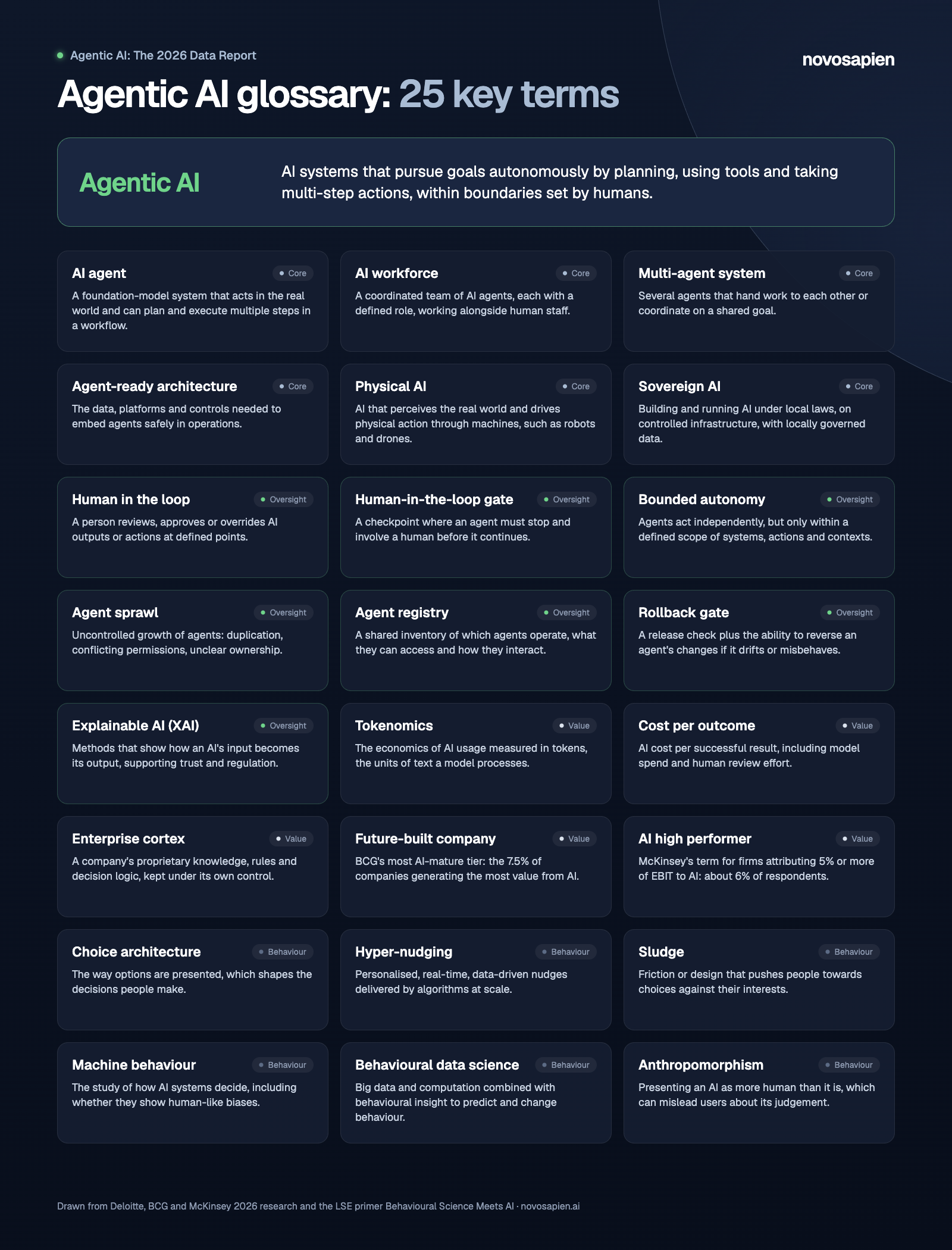
Agentic AI
AI systems that pursue goals autonomously by planning, using tools and taking multi-step actions within set boundaries.
AI agent
An AI system based on foundation models that acts in the real world and can autonomously plan and execute multiple steps in a workflow (McKinsey).
AI workforce
A coordinated team of AI agents, each with a defined role, working alongside human staff to deliver a business function.
Multi-agent system
Several agents that hand work to each other or coordinate on a shared goal.
Human in the loop (HITL)
A design in which a person reviews, approves or overrides AI outputs or actions at defined points.
Human-in-the-loop gate
A checkpoint where an agent must stop and involve a human before continuing, usually for accountability.
Bounded autonomy
Agents act independently, but only within a defined scope of systems, actions, purposes and contexts.
Agent sprawl
Uncontrolled growth of agents, leading to duplication, conflicting permissions, unclear ownership and monitoring gaps (BCG).
Agent registry
A shared inventory showing which agents operate, what they can access and how they interact.
Agent-ready architecture
The data, platforms and controls needed to embed agents safely in operations.
Rollback gate
A release check and the ability to reverse an agent's changes if it drifts or misbehaves.
Tokenomics
The economics of AI usage measured in tokens, the units of text a model processes.
Cost per successful outcome
BCG's preferred AI cost measure, including model spend and the human effort to review the work.
Enterprise cortex
BCG's term for a company's proprietary knowledge, business rules and decision logic, kept under its own control.
Future-built company
BCG's most AI-mature tier: 7.5% of companies, which generate the most value from AI.
AI high performer
McKinsey's term for organisations attributing 5% or more of EBIT to AI: about 6% of respondents.
Sovereign AI
Designing, training and deploying AI under local laws, on controlled infrastructure, with locally governed data (Deloitte).
Physical AI
AI that perceives the real world and drives physical action through machines, such as robots and drones.
Choice architecture
The way options are presented, which shapes the decisions people make.
Hyper-nudging
Personalised, real-time, data-driven nudges delivered by algorithms at scale (LSE primer).
Sludge
Friction or design that pushes people towards choices against their interests.
Machine behaviour
The study of how AI systems make decisions, including whether they show human-like cognitive biases.
Behavioural data science
Combining big data and computational methods with behavioural insight to predict and change behaviour.
Explainable AI (XAI)
Methods that show how an AI system's input becomes its output, supporting trust and regulation.
Anthropomorphism
Presenting an AI as more human than it is, which can mislead users about its judgement.
Agentic AI FAQs
What is agentic AI in simple terms?
Agentic AI is AI that gets things done rather than just answering questions. You give it a goal, and it plans the steps, uses software tools, takes actions and checks the results, with people setting limits and approving key decisions.
What is the difference between agentic AI and generative AI?
Generative AI creates content, such as text, images or code, when asked. Agentic AI uses that capability to act: it chains steps together, calls tools and systems, and completes a task towards a goal. Generative AI produces an output for a human to use; agentic AI performs the work itself, within defined boundaries.
Is agentic AI the same as an AI agent?
Nearly. Agentic AI is the broader approach or capability. An AI agent is one system built that way. A business might run an AI workforce made up of several agents, each with a specific role.
How many companies use agentic AI in 2026?
23% of companies use agentic AI at least moderately today, rising to 74% within two years (Deloitte). About two in ten organisations are scaling AI agents enterprise-wide, and 40% of companies with revenue over $1 billion are scaling agents in at least one function (McKinsey).
Does agentic AI deliver ROI?
For companies that redesign work around it, yes. BCG's future-built companies realise 3.3% revenue uplift and 3.4% cost reduction from AI, and agentic AI's share of AI value is set to rise from 22% to 39% by 2030 (BCG). Across all firms, only 37% report EBIT impact so far (McKinsey).
What does human in the loop mean for AI agents?
It means defining the points where a person must review, approve or override what an agent does before it takes effect. Human oversight ranges from fully automated to fully human-dependent (LSE primer). For agents, the most common pattern is bounded autonomy with human-in-the-loop gates for high-stakes or irreversible actions.
What are the biggest risks of agentic AI?
Unauthorised or unintended actions, data privacy and security breaches, errors spreading through agent memory, agent sprawl and weak accountability. Only 21% of companies have mature agent governance (Deloitte) and only 5% have all relevant controls in place (BCG).
How do you govern AI agents?
Put controls in place before granting autonomy. BCG names six: memory and context handling, scope and oversight, evaluation and rollback, tools and integration, named ownership, and security with audit trails. Companies with all six enterprise-wide generate three times the agentic value (BCG).
Will agentic AI replace jobs?
It will reshape most jobs and remove some. 89% of companies expect AI to create new work and companies expect a 10% to 15% workforce reduction overall, concentrated in middle layers (BCG). Last year's headcount predictions proved too high: 32% expected declines, but only 14% saw them (McKinsey).
Why does behavioural science matter for agentic AI?
Because adoption and outcomes depend on human behaviour. Fewer than 60% of workers with AI access use it daily (Deloitte), and agents that recommend, default or nudge are doing choice architecture at scale. Behavioural science helps design trustworthy hand-offs, avoid manipulation and drive real usage.
Which business functions benefit most from AI agents?
Agents are most often scaled in IT, knowledge management, software engineering and service operations. Cost savings are most reported in supply chain, service operations and manufacturing; revenue gains in marketing and sales (McKinsey). Deloitte expects the highest agentic impact in customer support.


