AI Content for Agencies: Scale Client Brands Without Chaos
Run content for many client brands with separate voices, accounts and approvals on one weekly rhythm. See how agencies scale without the chaos.


Scaling content across many client brands without chaos means giving each brand its own voice, pillars and accounts, while running every brand on one shared weekly rhythm.
A Content Workforce does this with an isolated workspace per brand and one portal for the agency, so volume rises without voices blurring or approvals slipping.
Key takeaways
- Growth is not the same as profit. In Productive's 2025 survey of 93 agency leaders, 59% grew revenue but only 31% improved their margins.
- Planning is thin. 52% of those agencies allocate resources four weeks or less before work begins, and 46% of growing agencies still operate week to week.
- Clients pay for consistency. A Lucidpress study of 200+ organisations found consistent branding can increase revenue by 33%.
- On the Content Creation Workforce, every brand is a fully isolated workspace with its own voice, pillars, identity and connected accounts, and agencies manage them all from one portal.
Why does agency content get chaotic as client numbers grow?
Every new client brings a voice, a set of pillars, a handful of accounts and a person who has to approve. The people doing the work stay the same. So each new client adds context-switching, and the context gets thinner.
The data points the same way. The Content Marketing Institute's B2B outlook for 2025 found that 42% of marketers struggle to create content consistently, 43% to differentiate it, and 54% name lack of resources as a top challenge. (That survey covers in-house B2B teams, not agencies, but the pressure is the same one agencies feel across a client list.)
Productive's 2025 agency report shows the business side. 59% of agencies grew revenue, only 31% improved margins, and fewer than half operate above 10% margins.
Nearly one in five cannot report their margins at all. Most agencies reach for headcount to keep up, and that is exactly the headcount ceiling we covered in Article 3 (link goes live with that post).
What does "one workforce, many brands" mean?
It means two things at once. Everything that makes a brand itself stays separate. Everything that makes the work efficient is shared.
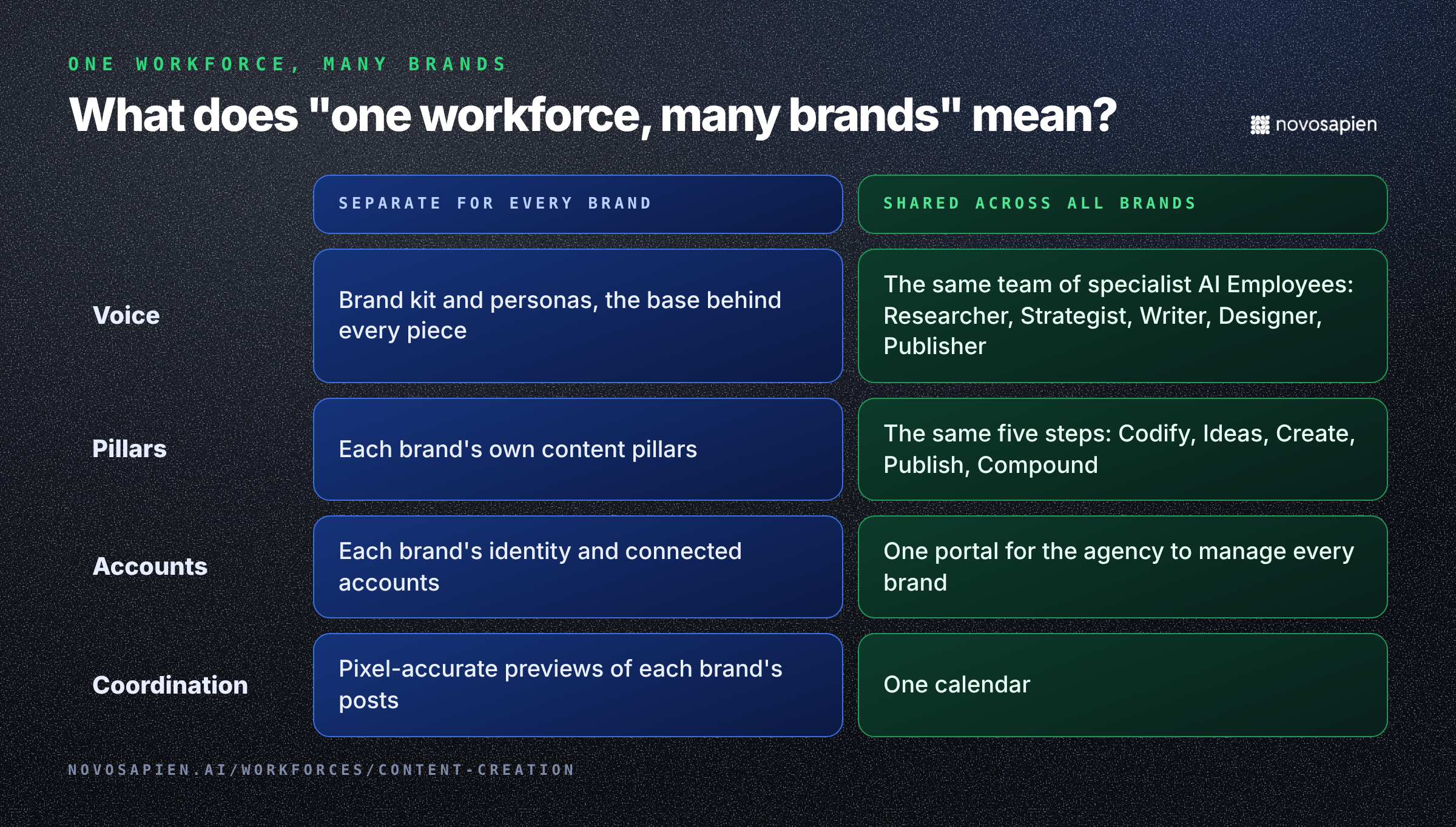
Novosapien builds AI Workforces for revenue work, and the Content Creation Workforce is built for exactly this shape. On the product page, the wording is direct: "Every brand is a fully isolated workspace with its own voice, pillars, identity, and connected accounts." Agencies "manage them all from one portal, with structured onboarding for each new client."
How does a weekly rhythm keep many brands in step?
Separation stops brands from blurring. Rhythm stops the work from slipping. The workforce takes an idea through scored ideas, drafted posts, visual assets, publishing and feedback loops, and you can run every brand through the same weekly pattern.
Here is one way to run it. This is a suggested operating rhythm, not a product specification:
- Start of the week: review the scored ideas for each brand and pick what goes forward.
- Midweek: review drafts and visual previews, one brand at a time, and approve.
- Rest of the week: approved posts publish to each brand's connected accounts.
- End of the week: feedback from what published informs next week's ideas.
The point is that the rhythm is the same for ten brands as it is for three. Only the voice changes.
Who keeps the final say?
The agency does. This matters most in agency work, because the client's name is on the post. On the Content Creation Workforce, "You set the approval threshold. Nothing publishes until you say so." You decide how much review each piece needs.
That fits how Novosapien describes its approach on the mission page: "Humans move up, not out." Your team spends its time on client strategy, point of view and relationships, and less on the production work that multiplies with every new account.
Why does separation protect the client relationship?
Because consistency is what clients are paying for. Lucidpress's State of Brand Consistency report, which surveyed more than 200 organisations and was published in 2019, found that consistent branding can increase revenue by up to 33%. It is a vendor study, so treat the figure as directional, but the logic holds for agencies: a client who sees their own voice every week keeps trusting the work.
The risk runs the other way too.
A post that sounds like a different client is the fastest way to lose confidence. Isolated workspaces are designed to keep each brand's voice, pillars and accounts apart, so the risk is managed by structure and not by memory.
What should an agency check before adding a new client brand?
- Has the brand's voice been captured from its brand kit, pillars and personas?
- Are the right accounts connected, and only that brand's accounts?
- Who approves, and how much review does each type of post need?
- Where does the brand sit in the weekly rhythm?
- What is the first piece you will approve, and what will you learn from it?
If those five answers are clear, a new client is a new workspace, not a new scramble.
Speak to Novosapien about running your client brands on one workforce.
FAQ
What does a multi-brand content workflow look like for an agency?
Each client brand gets its own voice, pillars, identity and connected accounts, so nothing blends. All brands then run on one shared weekly rhythm covering ideas, creation, publishing and feedback. The agency manages everything from a single portal and approves content before it goes live.
How do you keep brand voice separate across clients?
Give each client a fully isolated workspace. In Novosapien's Content Creation Workforce, every brand has its own voice, pillars, identity and connected accounts, built from its brand kit, pillars and personas. Isolation is what keeps one client's tone out of another client's content.
Can agencies use AI content without losing control?
Yes. On the Content Creation Workforce you set the approval threshold and nothing publishes until you say so. The agency keeps the final say on every client's content, with pixel-accurate previews and one calendar to review the work before it goes live.
How do you onboard a new client brand?
Novosapien describes structured onboarding for each new client, covering the brand and its content pillars. That setup becomes the base behind every piece the workforce creates, so a new brand starts from its own voice and pillars and not from a generic template.
Which channels does the Content Workforce publish to?
Today the Content Creation Workforce publishes straight to LinkedIn and X. Novosapien lists TikTok, YouTube and Instagram as rolling out. Check the product page for the current channel list before you promise a client a specific platform.
Related Articles

ChatGPT vs an AI Content Workforce: We Ran a Blind Test on the Same Brief
In our test, the AI content workforce produced the stronger article, before and after feedback. ChatGPT wrote a clear, balanced overview with no data. The Novosapien Content Workforce wrote a specific, commercially grounded argument with a worked financial example, a memorable framework and a hook built on a real moment in an agency owner's week.

Chatbot vs AI Content Team: What Is the Difference?
A chatbot writes when you prompt it. An AI content workforce plans, produces, publishes and learns. See the difference and when each one fits.

AI Content Workforce: Scale Content Without Hiring
The Content Workforce is a team of AI agents that proposes, writes, designs and publishes your content. You stay in control and approve everything.